You’re standing in downtown Austin, maybe just finished a taco at Veracruz, and you’re thinking about hitting the River Walk. It’s a classic Texas move. But the question of how far Austin to San Antonio actually is depends entirely on whether you’re looking at a map or looking at your dashboard during rush hour.
Technically, it’s about 80 miles.
On a Sunday morning at 6:00 AM, you can zip between the two city centers in about an hour and fifteen minutes. It's a breeze. You set the cruise control, watch the Hill Country scrub brush fly by, and you’re there before your coffee gets cold. But Texas is growing. Fast. That stretch of Interstate 35 is no longer just a highway; it’s basically becoming one giant, continuous metropolitan corridor. If you hit it at 4:30 PM on a Friday? Well, God bless you. That 80-mile trip can easily balloon into a three-hour odyssey of brake lights and frustration.
The Raw Data: Mileage and Drive Times
Let's talk brass tacks. If you go from the Texas State Capitol in Austin to the Alamo in San Antonio, the odometer is going to register roughly 79 to 82 miles depending on which lane changes you make.
Most people just say "an hour and a half." That’s the standard local shorthand. But "how far Austin to San Antonio" is a measurement of patience as much as distance. The Texas Department of Transportation (TxDOT) has been screaming about the I-35 corridor for years because it’s one of the most congested stretches of pavement in the entire United States.
You’ve got a few main ways to play this:
- The I-35 Route: This is the direct shot. It's the shortest distance. It’s also where every semi-truck in the Western Hemisphere seems to congregate.
- The SH-130 Toll Road: This is the "I’m in a hurry and I have a TollTag" route. It loops East. It’s actually more miles—usually around 90-95 miles total—but the speed limit is 85 mph. It’s the fastest legal speed limit in the country. You’ll pay for the privilege, but you avoid the nightmare of San Marcos traffic.
- The Scenic Route (Hwy 281): If you have all day, you go west. You take Highway 290 out of Austin to 281 and head south. It’s beautiful. It’s also slow. We’re talking nearly 100 miles and a lot of traffic lights in towns like Blanco.
Why San Marcos is the Great Barrier
Every local knows that the distance isn't the problem. The problem is San Marcos.
Situated almost exactly in the middle, San Marcos is the bottleneck. You’ve got Texas State University students, outlet mall shoppers, and people just trying to get through town. When you ask how far Austin to San Antonio is, you are really asking "how long will I be stuck in San Marcos?"
I’ve seen traffic at a dead stop at 2:00 PM on a Tuesday for literally no reason. No wreck. No construction. Just... "phantom braking." It’s a real phenomenon where one person taps their brakes, and five miles back, someone comes to a complete halt.
The "Austin-San Antonio" Mega-Region Reality
Urban planners are starting to call this the "Austantonio" or "San Austin" corridor. Honestly, the gap between the two cities is shrinking every year.
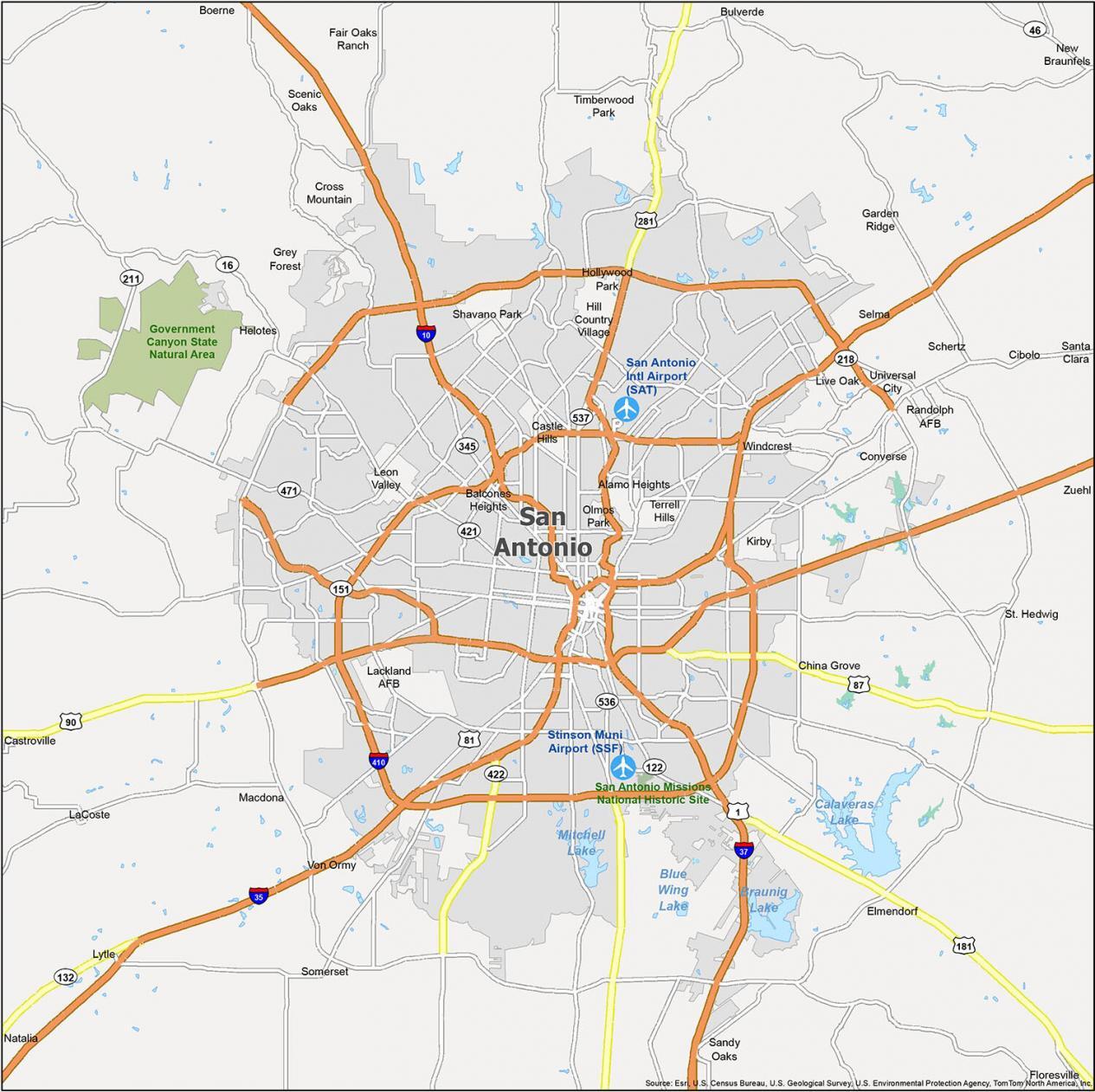
Twenty years ago, you’d leave Austin, hit some empty fields, pass through Kyle and Buda (which were tiny), and then see San Marcos. Today? It’s almost entirely developed. New Braunfels is exploding. Selma and Schertz are now major suburbs of San Antonio that practically touch the northern edge of the city.
According to the U.S. Census Bureau, the Austin-Round Rock-Georgetown and San Antonio-New Braunfels metro areas are among the fastest-growing in the country. When people ask about the distance, they often forget that "San Antonio" starts way before you see the Tower of the Americas. You hit the city limits of Schertz and you’re basically in the San Antonio orbit.
Choosing Your Weapon: Car, Bus, or Rail?
Most people drive. It’s Texas. We love our trucks and our AC. But you do have options if you don't want to stare at the bumper of a Peterbilt for 90 minutes.
The Amtrak Texas Eagle is an interesting vibe. It’s cheap. It’s usually around $10 to $20. But here’s the kicker: it’s notoriously unreliable for timing because it shares tracks with freight trains. It might take two hours; it might take four. It’s great if you want to drink a beer and look at the window, but terrible if you have a meeting.
The Vonlane is the "private jet on wheels." It’s a luxury bus. Big leather seats, Wi-Fi that actually works, and snacks. It’s expensive—sometimes $50 or more—but if you’re trying to work while traveling the distance from Austin to San Antonio, this is the only way to do it without losing your mind.
Greyhound and FlixBus also run the route constantly. It’s functional. It gets you from the Austin Eastside to the San Antonio Greyhound station near the River Walk. It’s fine. Just fine.
Timing is Everything (The "Golden Window")
If you want to experience the shortest version of how far Austin to San Antonio actually feels, you have to time your exit.
Whatever you do, do not leave Austin between 3:30 PM and 6:30 PM. Just don't. You will sit at the I-35/Hwy 290 interchange for twenty minutes just to move half a mile. Similarly, do not try to enter San Antonio from the north during the morning commute. The "Golden Window" is usually 10:00 AM to 1:30 PM. If you hit the road then, you’ll actually enjoy the drive.
You’ll pass the Buc-ee's in New Braunfels. If you haven't been, it's a gas station the size of a shopping mall. It’s a mandatory stop for many, which adds about 30 minutes to your "travel time" because you'll inevitably spend $40 on beaver nuggets and jerky.
Surprising Facts About the Journey
Most people think the drive is a straight line south. It’s actually more of a southwest diagonal.
Also, the elevation change is subtle but there. Austin sits a bit higher than San Antonio. You’re dropping down from the edge of the Balcones Escarpment into the flatter plains.
- Distance in Kilometers: For international travelers, it's about 129 km.
- Fuel Cost: In a standard sedan, you’re looking at maybe $8-$12 in gas, depending on how much you idle in traffic.
- Flight Time: There are no commercial flights. It would take longer to clear security at AUS than to drive to San Antonio.
Practical Steps for Your Trip
Stop thinking about the mileage and start thinking about the logistics. If you're planning this trip, here is how you actually handle the how far Austin to San Antonio dilemma:
- Check Waze BEFORE you leave the house. Not when you get in the car. Before. If I-35 is purple (which means "very bad"), commit to the SH-130 toll road immediately. It’s worth the $15 or so in tolls to save 45 minutes of stop-and-go stress.
- Pick your "In-Between" stop. New Braunfels is the best midway point. If the traffic looks heavy, pull off, grab some German food at Krause’s Cafe, and wait out the rush.
- Radio/Podcasts. Ensure you have at least two hours of audio queued up. Even on a good day, the mental load of I-35 is heavy. You need a distraction from the aggressive tailgating that is a local pastime.
- Destination Logic. Remember that getting to San Antonio isn't the same as getting into San Antonio. If you’re going to the La Cantera area (Northwest), take Loop 1604. If you’re going to the Pearl District or Downtown, stay on I-35 but stay in the left lanes as you approach the city to avoid the massive "split" confusion near downtown.
The distance is fixed, but the experience is highly variable. Treat it like a mission, plan for the San Marcos slowdown, and never, ever trust a GPS estimate that says "75 minutes" during a rainstorm. It’s lying to you.
Check your tire pressure before heading out, especially in the Texas summer heat. The friction on I-35 combined with 100-degree pavement is a recipe for blowouts. Stick to the middle lane through Kyle and Buda to avoid the constant merging of local traffic, and keep your eyes on the road—this stretch of highway is as beautiful as it is hectic.