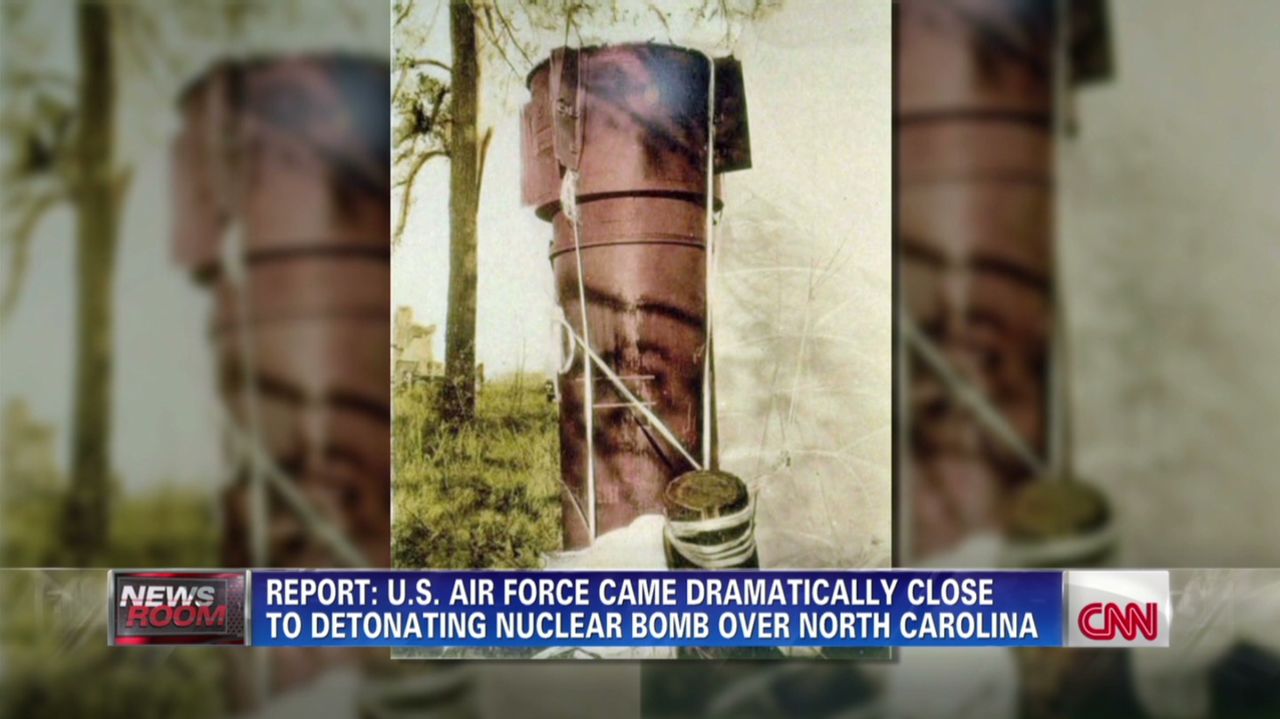
It was just past midnight on January 24, 1961. Most people in Wayne County, North Carolina, were sound asleep. They had no idea that a Boeing B-52G Stratofortress was disintegrating directly above their farmhouses.
The plane was carrying two Mark 39 hydrogen bombs.
These weren't small tactical nukes. We’re talking about 3.8-megaton monsters. Each one packed more punch than 250 Hiroshimas. When the plane broke apart, those bombs didn't stay with the wreckage. They fell. One floated down on a parachute and got tangled in a tree. The other slammed into a swampy field at 700 miles per hour.
Honestly, it’s a miracle North Carolina still exists as we know it. For decades, the government told us everything was under control. They said the bombs were "unarmed" and there was "no danger." But declassified documents from 2013 tell a much scarier story.
The Night the Sky Broke
The flight was part of a routine "Cover All" mission. The B-52 was based out of Seymour Johnson Air Force Base. Basically, the U.S. kept nukes in the air 24/7 during the Cold War just in case the Soviets pulled a fast one.
Major Walter Scott Tulloch was the commander. Everything seemed fine until they met up with a tanker for mid-air refueling. The tanker crew looked over and saw fuel pouring out of the B-52’s right wing.
Thirty-seven thousand pounds of fuel vanished in three minutes.
Tulloch tried to get the bird back to the base. He didn't make it. As they descended through 10,000 feet, the pilots lost all control. The plane started spinning wildly. Tulloch ordered the crew to bail. Five guys made it out alive. One survived the jump but died on landing. Two others never made it out of the cockpit.
Why the Goldsboro NC Nuclear Bomb Almost Went Off
This is where it gets terrifying.
When the plane started breaking up, the centrifugal forces were so intense they actually pulled the "release" lanyards. The bombs thought they were being intentionally dropped over a target.
On the first bomb—the one with the parachute—three of the four arming sequences actually finished. The "Arm/Safe" switch was the only thing that didn't flip.
Wait. It gets worse.
On the second bomb, the one that plummeted into the mud near Faro, the "Arm/Safe" switch did flip to "Armed."
According to Parker F. Jones, who was a senior engineer at Sandia National Laboratories, only one single, low-voltage switch stood between the United States and a total catastrophe. He wrote a secret memo titled "Goldsboro Revisited" about eight years after the crash. He didn't mince words. He said the Mark 39 wasn't safe enough for airborne alerts because a simple mechanical failure could—and nearly did—cause a detonation.
The Missing Piece in the Mud
The military spent weeks digging in the Faro swamp. They found the first bomb pretty easily. It was just hanging there in a tree, looking almost peaceful.
The second one was a nightmare.
It hit the soft, waterlogged earth so hard it buried itself deep. They dug down 50 feet. They found the tail. They found the parachute. They even found the secondary stage.
But they never found the "pit"—the core containing the highly enriched uranium.
The ground was too swampy. The hole kept flooding. Eventually, the Air Force just gave up. They bought a permanent easement for that specific patch of land. To this day, you aren't allowed to dig or build there. The U.S. government basically owns a circle of North Carolina farmland because there's a piece of a nuclear bomb still sleeping under the corn and tobacco.
What Most People Get Wrong
You'll hear people say the bomb would have wiped out the whole East Coast. That’s a bit of an exaggeration, but not by much.
A 3.8-megaton blast would have created a fireball over a mile wide. The thermal radiation would have caused third-degree burns to anyone standing 15 miles away. Winds would have reached hundreds of miles per hour.
The fallout? That's the real kicker. Depending on the wind that night, a radioactive cloud could have drifted over Norfolk, Washington D.C., and even New York City.
Another common myth is that the bombs were "dummy" rounds. They weren't. They were fully functional thermonuclear weapons. The only reason they didn't go off wasn't because they lacked the "juice"—it was because of a few small pieces of metal and some very lucky wiring.
Lessons from the "Broken Arrow"
The Goldsboro incident led to massive changes in how the U.S. handles nuclear weapons.
- Permissive Action Links (PALs): President Kennedy was reportedly shaken by how close we came to a disaster. He ordered the installation of PALs, which are basically "combination locks" that prevent a bomb from being armed without a specific code from the Commander in Chief.
- Safety Redundancy: Engineers realized that mechanical switches aren't enough. Modern weapons use "strong links" and "weak links" designed to ensure that if a plane crashes, the bomb's firing circuit breaks before it can ever send a signal to detonate.
- Ending Airborne Alerts: Eventually, the U.S. realized that keeping nukes in the air 24/7 was a recipe for disaster. The program was scaled back and eventually ended after other "Broken Arrow" incidents in Spain and Greenland.
If you ever find yourself driving through Wayne County, you can find a historical marker about three miles north of the crash site. It’s a quiet spot. Just some fields and trees. It’s hard to imagine that underneath that dirt lies a reminder of the night the world almost changed forever.
How to Explore the History
If you're a history buff or a "dark tourism" fan, you can't actually go dig for the bomb (don't try, the Air Force will not be happy). However, you can see the impact of this event:
- Visit the Historical Marker: Located on NC 111, it’s a quick stop that puts the scale of the event into perspective.
- Read "Command and Control": Eric Schlosser’s book is the gold standard for understanding this incident. He used the Freedom of Information Act to get the documents the government tried to hide for fifty years.
- Check Out the Wayne County Museum: They occasionally have exhibits related to Seymour Johnson AFB and the local history of the Cold War.
Check your local radiation maps if you're paranoid, but the state still monitors the groundwater in Faro. So far, everything is clear. The uranium is staying put.
Next time you hear about nuclear safety, remember that one tiny switch in a North Carolina swamp. It’s the only reason the history books look the way they do today.
Actionable Insight: For those interested in the technical side of Cold War history, the declassified "Jones Report" is available online through the National Security Archive. It provides a chilling, switch-by-switch breakdown of exactly which safety features failed and which one held. Familiarizing yourself with these documents offers a rare, unvarnished look at the inherent risks of nuclear deterrence.