You can’t talk about 90s country without talking about 1992. That was the year George Strait decided to pivot. He didn't just release another album; he starred in a movie. Pure Country hit theaters, and while critics weren't exactly lining up to hand him an Oscar, the soundtrack became a monster. It’s still his best-selling album to date. Right in the middle of that tracklist sits King of Broken Hearts George Strait, a song that basically defines why he’s called the King of Country in the first place.
It’s a weirdly perfect song.
Think about the context. George was playing Dusty Chandler, a superstar who gets tired of the smoke machines and the hairspray and goes back to his roots. The song itself feels like that journey. It’s stripped back. It’s got that swing. It’s got that specific, mournful fiddle that makes you want to order a beer at 10:00 AM.
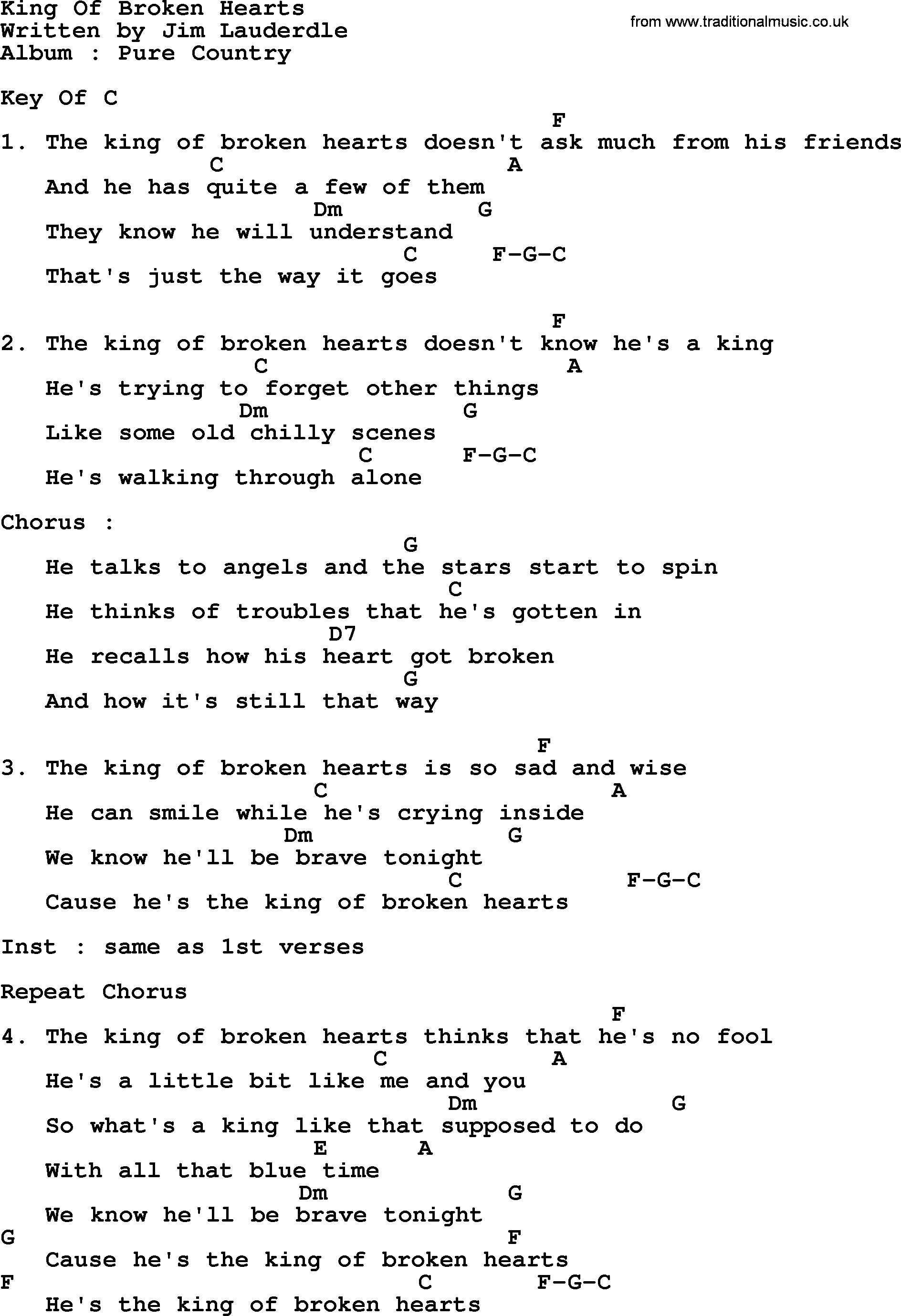
Jim Lauderdale wrote it. He actually wrote it as a tribute to Gram Parsons and George Jones. When you listen to the lyrics, you realize it’s not just a song about a guy who's sad. It’s a meta-commentary on the genre of country music itself. It’s about the person who carries the burden of everyone else’s sorrow.
Why George Strait King of Broken Hearts Hit Differently in 1992
Most people forget that by 1992, "New Country" was exploding. Garth Brooks was flying across arenas on wires. Shania Twain was right around the corner. Everything was getting louder, flashier, and a little bit more "pop."
Then comes George.
He wears a starched Wrangler shirt. He stands still. He sings a song like King of Broken Hearts George Strait that sounds like it could have been recorded in 1965 or 2025. That’s his superpower. He doesn’t chase trends. He just waits for the trends to circle back to him.
The song peaked at number 28 on the Billboard Hot Country Singles & Tracks. Now, to some, that might look like a "soft" hit compared to his 60 number ones. But stats are liars. If you go to a Texas dance hall tonight, they aren't playing the songs that hit number one in September of '92. They’re playing this. It’s a "lifestyle" hit. It’s the kind of track that DJs use to fill the floor for a two-step because the tempo is exactly $120$ beats per minute of pure honky-tonk perfection.
The Lauderdale Connection
Jim Lauderdale is a songwriter’s songwriter. He’s the guy Nashville legends go to when they want something with a bit of "dirt" on it. When he wrote this, he was thinking about the lineage of heartbreak.
"I was really influenced by George Jones and Gram Parsons. I wanted to capture that feeling of being the person everyone looks to when their world falls apart." — Jim Lauderdale in various Nashville retrospective interviews.
Strait took that raw, indie-country vibe and polished it just enough for the radio without losing the soul. It’s got that "high lonesome" sound but with the smoothness of a high-end bourbon. Honestly, that’s the Strait magic. He’s the bridge between the rough-edged outlaws and the polished superstars.
The Pure Country Factor
You can’t separate the song from the film. In Pure Country, Dusty Chandler is struggling with the "spectacle" of fame. When he sings King of Broken Hearts George Strait, it feels like he’s reclaiming his identity.
The movie was a bit of a gamble. George wasn't an actor. He’s famously private, almost shy. But the camera loved him because he didn't try to act; he just existed. The soundtrack went 6x Platinum. Let that sink in. Six million copies.
- It stayed at #1 on the Country Albums chart for weeks.
- It broke into the Top 10 of the Billboard 200.
- It solidified the "Strait" brand for a whole new generation of fans who weren't even born when "Unwound" came out in '81.
The arrangement of the song is a masterclass in restraint. There’s no over-the-top drum fill. There are no screaming guitar solos. It’s a shuffle. It relies on the interplay between the steel guitar and the fiddle. If you listen closely to the bridge, you can hear that classic Nashville A-Team session style where every note has a purpose. No ego. Just service to the song.
What Most People Get Wrong About the Lyrics
A lot of folks think this is just a standard "my girl left me" track. It’s not.
Look at the lines: "The king of broken hearts doesn't come around here no more." It’s about the absence of the comforter. It’s about the idea that even the person who is supposed to lead us through the dark times has checked out. It’s a lonely song. It’s about being abandoned by the very concept of empathy. Heavy stuff for a "cowboy movie," right?
George sings it with this nonchalant phrasing. That’s his trick. He doesn't oversell the emotion. He doesn't growl or cry. He tells you the news, and he lets you decide how to feel about it. That’s why he’s lasted forty years. If you over-emote, you date yourself. If you tell the truth simply, you’re timeless.
The Technical Brilliance of the Performance
Musically, the song sits in a comfortable range, but the phrasing is tricky. Strait has this way of sliding into notes—just a hair flat and then pulling it up to pitch—that creates a sense of tension. It’s a jazz technique, really.
The production by Tony Brown is peak 90s Nashville. Tony knew exactly how to make a record sound "expensive" while keeping the traditional instruments front and center. He gave the fiddle enough reverb to sound like it was playing in a vast, empty hall, which fits the theme of the King of Broken Hearts George Strait perfectly.
The Legacy of the "King" Title
Ironically, this song helped cement George’s own nickname. While the song is about a fictional "King of Broken Hearts," the public just started calling George "The King."
He’s the only artist in history to have a Top 10 hit every year for 30 years.
Think about that.
Three decades of relevance.
Most artists get five years if they're lucky. George stayed because he became the curator of the American heartbreak. He didn't just sing songs; he curated a vibe that people could rely on. When the world changed—through the 90s tech boom, through the 2000s, through the shift to streaming—George was still there, wearing the same hat, singing about the same neon lights and the same lost loves.
How to Actually Appreciate the Song Today
If you want to really "get" this song, don't listen to it on your phone speakers while you’re doing chores.
Do this instead:
- Wait until it’s late.
- Get in a car.
- Drive somewhere where you can see the horizon.
- Turn it up just loud enough that the steel guitar stings a little bit.
You’ll notice things. You’ll hear the way the bass walks during the chorus. You’ll hear the slight grit in George’s voice when he hits the lower register. You’ll realize that the song isn't just about sadness; it’s about the dignity of carrying on when you’re sad.
That is the core of the Strait philosophy.
Life is hard. People leave. The ranch is dry. But you get up, you put on the shirt, and you do the job.
Actionable Ways to Explore the Strait Catalog
If King of Broken Hearts George Strait is your entry point, don't just stop at the greatest hits. Dive into the deep cuts of the Pure Country era.
- Check out "Overnight Male": It shows his playful, uptempo side that often gets overlooked.
- Listen to "Thoughts of a Fool": It’s a cover of an old Ernest Tubb song that shows George’s deep respect for his elders.
- Watch the movie (seriously): It’s cheesy, sure. But it captures a very specific moment in American culture where country music was trying to figure out its soul.
George Strait isn't just a singer. He’s a standard. In a world of AI-generated hooks and over-processed vocals, a song like this serves as a reminder that three chords and the truth—plus a really good fiddle player—is all you actually need.
Go back and listen to the Pure Country version again. Pay attention to the silence between the notes. That’s where the real "King" lives.
Next Steps for the Serious Fan
To truly master the George Strait discography, start by tracing the songwriters. Don't just look for "George Strait songs"—look for songs written by Jim Lauderdale, Dean Dillon, and Aaron Barker. These men provided the blueprint for the Strait sound. Understanding the writers helps you understand why George chose King of Broken Hearts George Strait in the first place. He wasn't looking for a hit; he was looking for a story that felt like leather and wood. Once you find those writers, you'll find the heart of country music.