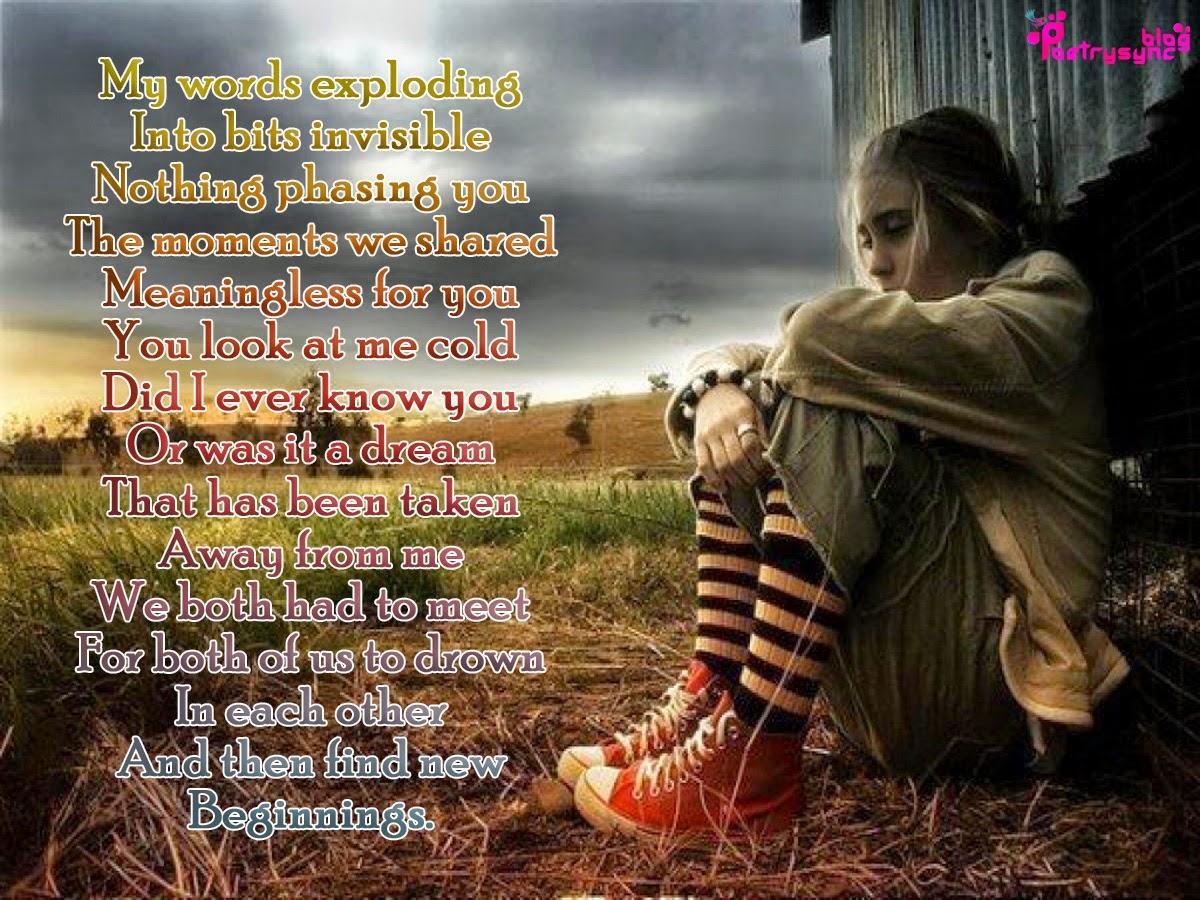
Sometimes you're just sitting there, staring at a wall, and the weight of everything—the bills, the burnt-out friendships, that lingering sense of "is this it?"—just hits you. It’s heavy. You want to describe it, but the words feel stuck in your throat like dry toast. That’s usually when people start hunting for a poem on sad life that doesn’t sound like a Hallmark card written by a robot. We don’t need rhyming couplets about "the rain in the lane." We need something that hurts because it’s true.
Poetry is weirdly good at that. It’s probably the only medium that can take a messy, jagged emotion like grief or existential dread and give it a shape you can actually hold onto.
Why a poem on sad life hits different than a TikTok rant
Honestly, there’s a biological reason we gravitate toward sad words when we're down. Psychologists often point to "catharsis," a term Aristotle popularized, which is basically a fancy way of saying we need to purge our emotions to feel clean again. When you read a poem on sad life, you aren't just wallowing. You’re finding proof that you aren't the first person to feel like the world is a cold, indifferent place.
Think about Sylvia Plath. People call her "depressing," but that’s a lazy take. In poems like The Thin People, she captures a specific kind of hollowness that feels incredibly modern. She isn't just "sad." She’s describing a depletion of the soul. Or look at Langston Hughes and his poem Dream Deferred. He asks if a dream just sags like a heavy load. That’s a physical sensation. You’ve felt that, right? That literal weight in your chest when things don't go your way for the tenth time in a row?
Modern digital culture tries to "fix" us. Buy this supplement. Do this 5-step morning routine. Manifest your joy. But a good poem on sad life doesn't try to fix anything. It just sits in the dark with you.
The nuance of the "sad" label
Calling something "sad" is kinda like calling the ocean "wet." It’s true, but it misses the point. There are different flavors of sadness. There's the sharp, staccato sadness of a breakup. There's the long, slow, grey sadness of burnout. There's the weird, nostalgic sadness of realizing your childhood home doesn't smell the same anymore.
The best poets know this. They don't use the word "sad." They use imagery. They talk about empty chairs, or the way light looks at 4:00 PM in November, or the silence after a phone stops ringing.
Famous examples that aren't just clichés
If you’re looking for a poem on sad life that actually carries weight, you have to look past the stuff you were forced to analyze in high school. Unless you had a really cool teacher.
- W.H. Auden - Funeral Blues: You might know this one from Four Weddings and a Funeral. It’s the one that starts with "Stop all the clocks." It’s visceral because it demands the whole world stop just because one person’s world has ended. That’s the most honest description of grief there is.
- Charles Bukowski - Alone With Everybody: Bukowski was a mess, let's be real. But he knew about the specific sadness of being in a crowd and feeling totally isolated. He writes about how we're all "flesh covered bones" just looking for something, and usually not finding it. It’s gritty. It’s not "pretty" poetry. It’s a poem on sad life for people who hate poetry.
- Warsan Shire - For Women Who Are Difficult to Love: This is a more contemporary take. Shire’s work is raw. She talks about the sadness of being "too much" for people. It’s about the exhaustion of trying to shrink yourself to fit into someone else’s life.
The trap of the "aesthetic" sadness
We have to talk about Instagram poetry. You know the ones. Three lines, centered on a white page, usually about "letting go" or "blooming."
There’s a place for that, sure. But often, those snippets lack the "teeth" that a real poem on sad life needs to have. They feel like they were written to be liked, not to be felt. Real sadness is messy. It’s ugly. It involves snot and regret and sometimes being a bit of a jerk to people who don't deserve it.
When you’re looking for words that resonate, look for the ones that make you feel a little bit uncomfortable. The ones that say the things you’re ashamed to think. Like the feeling of being relieved when a plan gets canceled because you just don't have the energy to pretend to be a person today.
Can writing your own help?
You don't have to be Keats. Honestly, you don't even have to be good. Writing your own poem on sad life is mostly about externalizing the internal.
When you keep a feeling inside, it’s a giant, shapeless monster. When you put it into words—even bad ones—you give it boundaries. You define it. You make it smaller than you.
Try this: don't write about how you feel. Write about what you see. Don't say "I'm lonely." Say "The leftovers in the fridge are three days old and I’m eating them over the sink." That’s a poem. That’s the reality.
The unexpected comfort of the "dark" poets
There is a weird paradox in reading dark stuff. You’d think it would make you feel worse. Usually, it’s the opposite.
There’s a study from the University of Tokyo that suggests listening to sad music actually evokes positive emotions because it provides a safe space to experience those feelings without the real-life consequences. Poetry works the same way. When you read a poem on sad life, you’re engaging in a controlled burn. You let the fire happen, but it’s contained within the stanzas.
Emily Dickinson was the master of this. She lived a tiny, quiet life in Amherst, but her poems are like tectonic shifts. She wrote about "a certain Slant of light" that "oppresses, like the Heft / Of Cathedral Tunes." She knew that sadness wasn't always a scream. Sometimes it’s just a change in the light.
Actionable steps for when the sadness feels like too much
Reading a poem on sad life can be a great first step, but it shouldn't be the only step if you’re actually struggling.
- Differentiate between "poetic melancholy" and clinical depression. If you can’t get out of bed or find joy in anything for weeks, that’s not a poem—that’s a medical situation. Talk to a professional.
- Curate your intake. If you’re already down, reading nothing but Sylvia Plath might actually keep you in the hole. Balance it out. Read something that acknowledges the pain but also acknowledges the endurance.
- Use "The Concrete Method." When you're feeling that vague, heavy sadness, find one concrete thing to describe. The texture of your sweater. The sound of the radiator. The way the coffee steam curls. It grounds you in the physical world.
- Find a community. Subreddits or local poetry slams can show you that your specific brand of "sad" is actually a universal language.
The goal isn't to stop being sad forever. That’s impossible. The goal is to find a way to live with it, to weave it into your story so it isn't the only thing on the page. A poem on sad life isn't a white flag. It’s a map. It shows you that someone else was in these woods, too, and they found enough light to write a few lines down before they moved on.
You aren't broken for feeling this way. You’re just paying attention. Life is hard, and sometimes it's disappointing, and acknowledging that through art is one of the most human things you can do. Go find the words that sound like your own heartbeat, even if that heartbeat is a little slow today.
Finding your next read
If you want to go deeper, look for anthologies that focus on "The Poetry of Witness" or modern collections like The Carry Letters. Avoid the "Top 10 Sad Poems" lists that just cycle through the same three Frost poems. Look for voices that sound like they've actually lived through a Tuesday in the 21st century.
Start by picking one poem. Read it out loud. Feel how the words sit in your mouth. Sometimes, just hearing the truth spoken into an empty room is enough to start the shift.