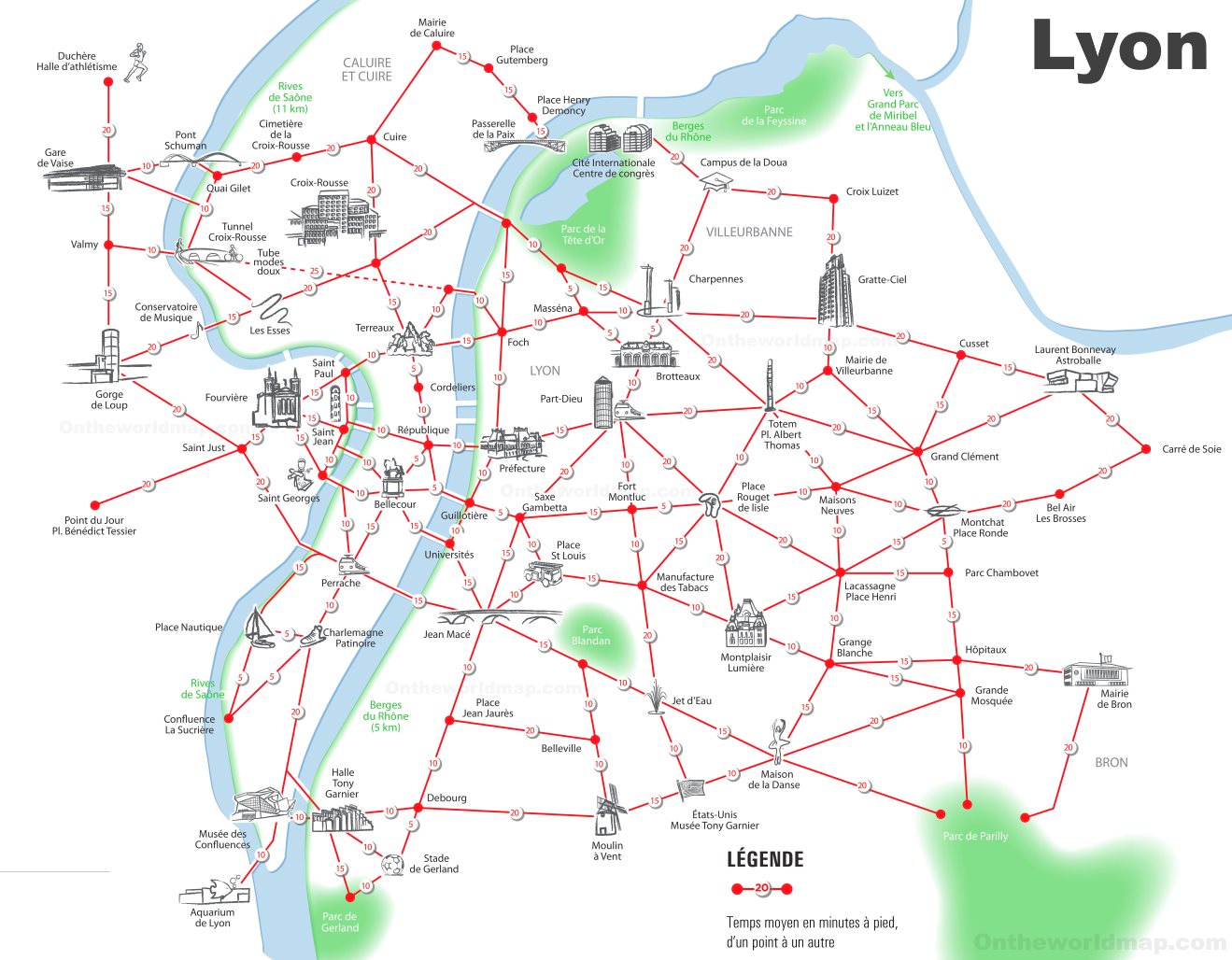
You’re looking at a map. Your finger probably drifts toward Paris first, right? Most people do. But if you slide your hand down about 400 kilometers toward the southeast, right where the country starts to tuck in toward the Alps, you'll hit a massive confluence of blue lines. That’s Lyon. Finding Lyon on France map isn't just a geography exercise—it’s the literal key to understanding why this city has been a powerhouse since the Romans were running the show.
It’s tucked into the Auvergne-Rhône-Alpes region. To the west, you’ve got the Massif Central mountains. To the east, the jagged peaks of the French Alps loom in the distance. It’s the gatekeeper.
Seriously, the location is everything. Lyon sits precisely at the junction of the Rhône and Saône rivers. Because of this, it became the "Capital of the Gauls" under Augustus. If you were a Roman merchant 2,000 years ago, you didn't just stumble upon Lyon. You had to go there. It was the hub for every road leading to Italy, Germany, and the Mediterranean.
Why the Map Doesn't Tell the Whole Story
When you see Lyon on France map, it looks like it’s just "in the middle-east" of the country. But maps are flat, and Lyon is anything but. The city is built on hills—specifically Fourvière and La Croix-Rousse.
Fourvière is known as the "hill that prays." It’s topped by the Basilica of Notre-Dame de Fourvière, which you can see from basically anywhere in the city. Then you have La Croix-Rousse, the "hill that works." This was the heart of the silk trade. The geography here forced the architecture to adapt, leading to the creation of traboules. These are secret passageways that run through buildings and courtyards, connecting streets at different levels. They were used by silk workers to transport delicate fabrics away from the rain. During World War II, the Resistance used them to dodge the Gestapo.
You can't see a traboule on a standard Google Map. You have to be there, feeling the damp stone and hearing the echo of your own boots.
The Strategic Hub: More Than Just a Dot
If you look at a transit map of Europe, Lyon is arguably more important than Paris for north-south logistics. It is the bridge.
- The TGV Connection: You can get from Lyon to Paris in two hours. You can get to Marseille in 1 hour and 40 minutes.
- The Geneva Gap: It’s only about 150 kilometers from Geneva, Switzerland.
- The Wine Axis: It sits right between the Beaujolais region to the north and the Côtes du Rhône to the south.
Basically, if you enjoy eating well or moving fast, Lyon’s coordinates are your best friend. The city isn't just a stopover. It’s a destination that has spent centuries perfecting the art of being "on the way."
Historically, this meant wealth. The silk industry didn't just happen by accident. It happened because the map allowed it. Merchants from Italy could easily reach the city, bringing techniques and raw materials. By the 16th century, Lyon was the banking capital of France. The Medicis had branches here. Think about that. The most powerful bankers in the world chose this specific spot on the map because of the rivers.
Navigating the Quarters
When you're trying to locate specific spots in Lyon on France map, you’ve got to think in terms of "arrondissements," just like in Paris. There are nine of them.
The 5th arrondissement is Vieux Lyon (Old Lyon). It’s one of the largest Renaissance neighborhoods in Europe. It feels cramped, medieval, and perfectly preserved. Then you cross the Saône into the 1st and 2nd arrondissements—the Presqu'île. This is the "peninsula" between the two rivers. It’s where the high-end shopping happens and where the Place des Terreaux sits.
Then you have the 3rd, which is the business heart. This is where the Part-Dieu train station lives. It’s also where you’ll find the "Crayon" (the Pencil), a skyscraper that defines the modern skyline. It’s a jarring contrast to the Roman ruins just a few miles away.
The Culinary Map: Why You’re Really Here
Let's be real. Most people searching for Lyon aren't doing it because they love cartography. They’re doing it because they’re hungry.
Curnonsky, the famous French food critic, dubbed Lyon the "World Capital of Gastronomy" in 1935. That title hasn't gone anywhere. The city’s location allows it to pull the best ingredients from every direction. You get chickens from Bresse, charcuterie from the local hills, and the freshest vegetables from the surrounding plains.
You need to look for a Bouchon. These are traditional Lyonnais restaurants. Don't expect tiny portions of "haute cuisine" here. Expect pig’s trotters, quenelles (creamy fish dumplings), and plenty of red wine. It’s hearty, heavy, and honest food.
Climate and Geography: What to Expect
Because of its position on the map, Lyon has a weird climate. It’s officially "semi-continental."
What does that mean for you? Well, it gets hot. In July, the heat reflects off the stone buildings and stays trapped between the hills. In the winter, the fog rolls off the rivers and gets into your bones. It’s moody. But that’s part of the charm. The light in Lyon during the "blue hour" just before sunset is unlike anything in Paris. The way the sun hits the ochre-colored buildings in Vieux Lyon makes the whole city look like it’s glowing from the inside.
Practical Logistics for the Modern Traveler
If you are planning a trip and staring at Lyon on France map, here is the ground-level reality of getting there.
Lyon-Saint Exupéry Airport (LYS) is about 20 kilometers east of the city center. Don't take a taxi if you can avoid it; it’s expensive. Use the Rhônexpress tram. It takes about 30 minutes and drops you right at Part-Dieu.
If you’re coming from London, the Eurostar used to run a direct line, but these days you usually have to swap in Paris or Lille. It’s still worth it. Seeing the French countryside blur past at 300 km/h is the proper way to arrive.
The Misconception of the "Second City"
People often call Lyon the "Second City" of France. Residents hate that. Marseille is technically larger by population in the city proper, but Lyon feels more significant in terms of influence. It’s more organized than Marseille and more relaxed than Paris.
It’s a city of secrets. While Paris puts everything on display, Lyon hides its best parts. You have to know which unmarked door to push to find a traboule. You have to know which basement leads to a jazz club. The map gives you the coordinates, but the city requires curiosity.
Actionable Insights for Navigating Lyon
If you're serious about exploring the city based on its unique geography, here is how you should actually spend your time.
First, get a "Lyon City Card." It sounds touristy, but it covers all public transport, including the funiculars that take you up Fourvière hill. Walking up is a vibe, sure, but your calves will thank you for taking the "Ficelle" (the string), as locals call the cable car.
Second, don't just stay in the center. Head to Parc de la Tête d'Or in the 6th arrondissement. It’s one of the largest urban parks in France. It has a lake, a free zoo (yes, free), and a massive botanical garden. It’s where the city breathes.
Third, understand the river banks. The banks of the Rhône have been developed into miles of walking and cycling paths. In the summer, there are "peniches" (barges) turned into bars docked along the shore. It’s the ultimate spot for an apéro.
Fourth, check the Fête des Lumières (Festival of Lights) dates if you're planning a winter trip. It happens around December 8th. This is when the entire city turns into a light installation. It’s beautiful, but it’s also crowded. If you don't like people breathing on you, stay away during that week.
Finally, use Lyon as a base. Because of its spot on the map, you can do day trips to Annecy (the Venice of the Alps), the medieval village of Pérouges, or the vineyards of Hermitage.
Finding Lyon on France map is just the start. The real work—and the real fun—begins when you realize that this city isn't just a point between Paris and the sea. It is the heart of the country, pumping history, silk, and wine through the veins of Europe.
Go there. Eat the praline tart. Walk the secret tunnels. Look at the rivers and realize that 2,000 years of people have stood exactly where you are, wondering why the air in Lyon tastes just a little bit different.
Next Steps for Your Trip:
- Pin the Confluence Museum: Located at the very tip of the peninsula where the rivers meet, it's a piece of futuristic architecture that explains the natural history of the region.
- Download the "Traboules" App: There are specific maps designed just to help you find the entrances to these hidden passages, as many are now private residences.
- Book a Bouchon in Advance: Real ones like Le Musée or Daniel et Denise fill up days or weeks ahead of time. Don't wing it with your dinner plans.