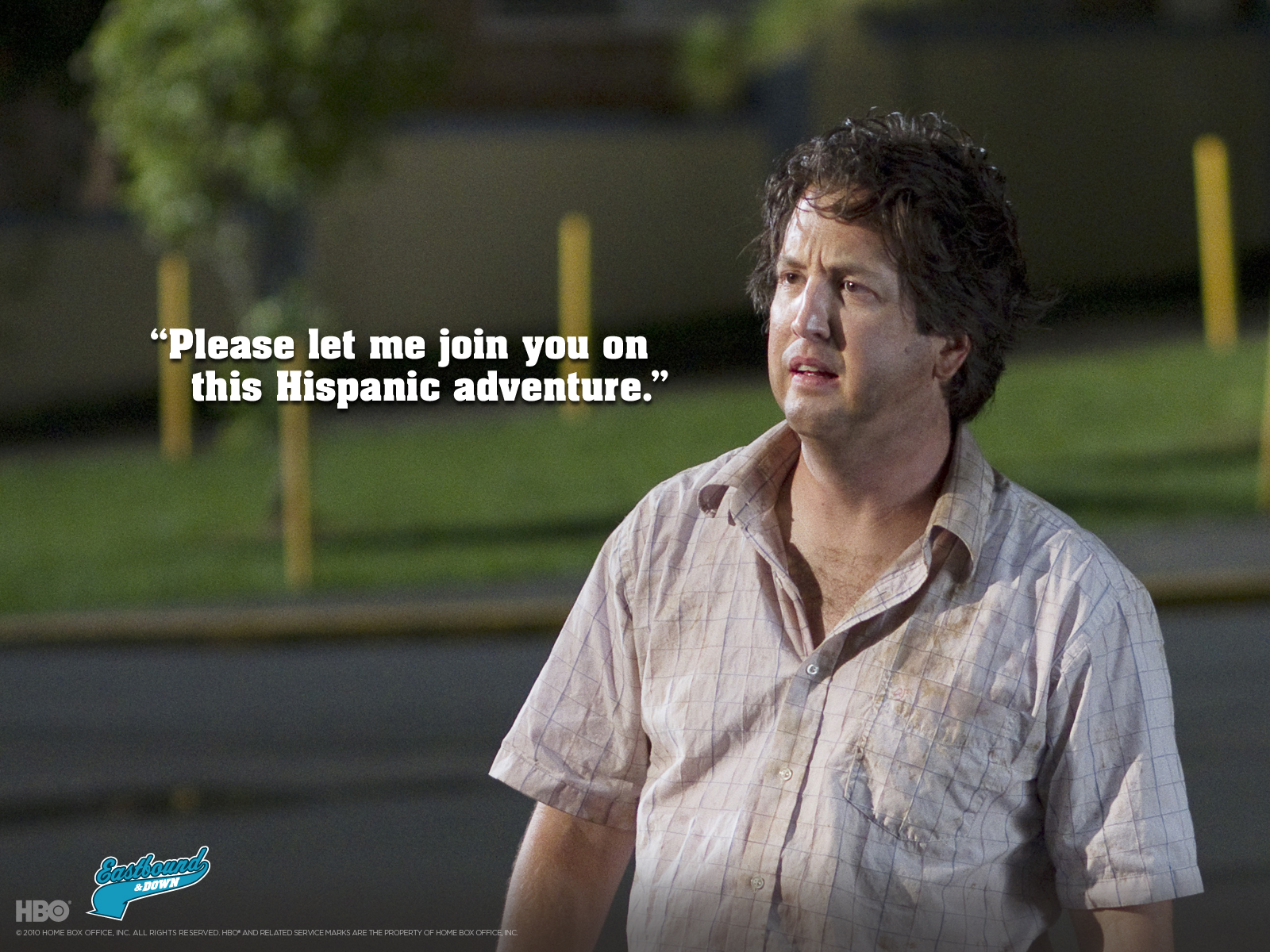
Let's be honest about something. Kenny Powers is a monster. He is a mulleted, jet-ski-riding hurricane of ego and bad decisions. But as much as we love to quote Danny McBride’s "I’m the man with the golden dick" rants, Eastbound and Down wouldn't work without the guy standing two feet behind him, sweating profusely and holding a box of steroids.
I’m talking about Stevie Janowski.
If you haven't revisited the show lately, you might remember Stevie as just the "pathetic friend." That’s a massive understatement. Played by Steve Little, Stevie Janowski is a fascinating, disturbing, and somehow heartbreaking study in what happens when a regular guy decides to worship a false idol.
The Evolution of a Band Teacher
When we first meet Stevie in Season 1, he’s a nobody. Literally. Kenny doesn’t even remember him from high school. He’s just a middle school band teacher living a quiet, beige life in Shelby, North Carolina. Then Kenny Powers walks into the gym, and Stevie’s brain basically melts.
It starts small. A few favors. A ride here and there. But Steve Little plays this transformation with such commitment that it becomes visceral. By the time they’re heading to Mexico in Season 2, Stevie has fully shed his old skin.
He doesn't just work for Kenny; he becomes a distorted mirror of him. He starts dressing in all black to "express his rage." He adopts Kenny’s profane vocabulary, though it sounds ridiculous coming from him. There’s a specific kind of tragedy in watching a man willingly incinerate his own identity just to be near someone he thinks is famous.
Steve Little: The Secret Weapon
The story of how Steve Little got the role is actually pretty legendary in comedy circles. He was a member of The Groundlings in Los Angeles—the same breeding ground that gave us Will Ferrell and Kristen Wiig.
When he auditioned for Eastbound and Down, he hadn't even met Danny McBride. In fact, Little later admitted that if he had known how big of a deal McBride was about to become, he probably would have been too nervous to land the part.
What makes his performance so "human" is the physical comedy. Think about the way Stevie stands. He’s always slightly hunched, looking like he’s expecting a blow to the head or a compliment, and he's not sure which one is coming. Most actors would play Stevie as a simple cartoon. Little makes him feel like a guy you actually knew in high school who just never found a reason to grow up.
Why the "Fixins" Scene Still Hits
You know the one. The dinner at April’s house. Stevie is sitting there, high as a kite, crying over a plate of food. "Makin' sure I got enough fixins." It’s one of the most quoted lines in the show's history, but it's also incredibly dark.
He’s a man at the end of his rope, finding solace in mashed potatoes because his hero is ignoring him. The show walks this razor-thin line between "this is hilarious" and "this man needs immediate psychological intervention."
The Dynamic of Absolute Abuse
Kenny treats Stevie like a literal dog. In Season 2, Kenny actually shoots Stevie in the leg. Does Stevie leave? No. He apologizes.
It’s easy to write this off as just "dark comedy," but there’s a nuance to the Eastbound and Down Stevie relationship that mirrors real-world toxic dynamics. Stevie is a "star-fucker." He’s the ultimate version of the guy who hangs around the locker room hoping for a crumb of reflected glory.
But here’s the twist: Kenny needs Stevie.
Without Stevie Janowski, Kenny Powers is just a lonely guy in a basement. Stevie provides the audience Kenny requires to exist. In the series finale, when we see the "future" versions of them, Stevie is still there. He’s still the one by his side. It’s the most twisted "happily ever after" in television history.
What Most People Get Wrong About Stevie
People often think Stevie is just "dumb." He’s not. He’s a college-educated band teacher. He’s capable of holding down a job and a marriage (shout out to Maria and the kids).
The tragedy isn't that he’s too stupid to know Kenny is a jerk; it’s that he knows and chooses him anyway. He chooses the chaos because his life before Kenny was a void.
- The Look: That chin-strap beard was a choice. Little has talked about how they wanted Stevie to look like he was trying way too hard to be "cool" but had no idea what that actually meant.
- The Voice: Notice how Stevie’s voice gets higher and more strained whenever he’s trying to be tough? That’s pure character work.
- The Loyalty: Even when Kenny leaves him at a gas station or abandons him in a foreign country, Stevie’s first instinct is to find a way back.
How to Watch Stevie Today
If you’re going back for a rewatch, pay attention to Stevie’s eyes.
While Kenny is screaming at someone, watch Steve Little in the background. He’s usually mimicking Kenny’s facial expressions or nodding along with a terrifying intensity. It’s a masterclass in "active listening" as a comedic tool.
Honestly, the show hasn't aged a day. In a world of "safe" sitcoms, the raw, unfiltered toxicity of the Powers-Janowski duo feels even more shocking now than it did in 2009.
Your Next Steps for an Eastbound Rewatch
If you want to appreciate the genius of the Eastbound and Down Stevie arc, don't just binge the whole thing. Focus on the transitions.
- Watch the Season 1 finale and the Season 2 premiere back-to-back. Notice how Stevie’s physical appearance changes as soon as he leaves the school system.
- Pay attention to the "Audiobook" scenes. These are the moments where Stevie is at his most vulnerable, acting as the scribe for Kenny’s delusions.
- Look for Steve Little’s cameos in other Jody Hill/Danny McBride projects like Vice Principals. It’s wild to see him play a completely different, competent human being after years of seeing him as Stevie.
The character is a reminder that we all have a little bit of a "Stevie" in us—that part of us that wants to belong to something "great," even if that greatness is just a washed-up pitcher with a drug problem and a bad attitude.