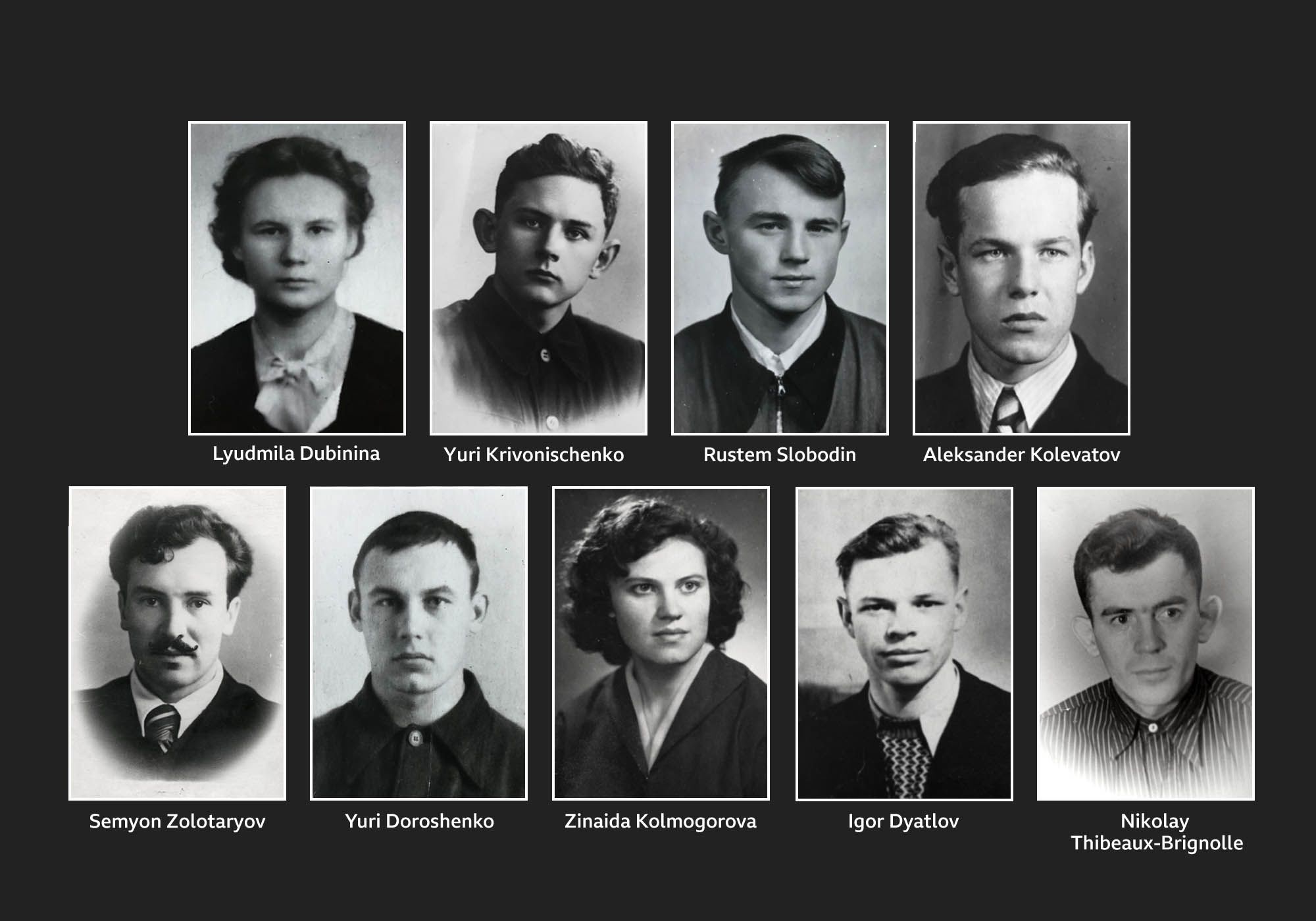
The Ural Mountains don't care about your experience level. In February 1959, they proved it. Nine hikers, led by the capable Igor Dyatlov, died on the slopes of Kholat Syakhl, a name that translates to "Dead Mountain." It’s a bleak place. Honestly, the way people talk about the Dyatlov Pass incident dead bodies today makes it sound like a horror movie set, but the reality is far more clinical and, in many ways, more disturbing.
People love to bring up the missing tongues or the radioactive clothing. They whisper about "orange spheres" in the sky. But if you actually look at the forensic files, you see a story of desperate survival followed by a very messy, very human collapse.
The First Discoveries: A Scene of Pure Chaos
The search party didn't find everyone at once. Not even close. On February 26, they stumbled upon the tent. It was half-buried in snow, slashed open from the inside. Why? Because whatever happened was so sudden they couldn't even unbutton the flap. They just cut their way out and ran into a -30°C blizzard.
Basically, they signed their own death warrants the moment they stepped out.
The first two Dyatlov Pass incident dead bodies were Yuri Doroshenko and Yuri Krivonishchenko. They were found 1.5 kilometers away, near a large cedar tree. They were dressed only in their underwear. No boots. Just socks and thin layers. They’d tried to build a fire, but the branches above them were snapped—evidence they’d been climbing the tree to scout for the tent or maybe for something chasing them.
Krivonishchenko’s autopsy revealed something haunting. He had a piece of skin from his own knuckle in his mouth. He’d bitten it off. Whether to stay awake or to stifle a scream from the cold, we’ll never know.
The Bodies Between the Tree and the Tent
Then there were the "returners." Three bodies were found spaced out between the cedar tree and the tent, as if they were crawling back in a line.
- Igor Dyatlov: Found face-up, clutching a birch branch.
- Zinaida Kolmogorova: Found further up the slope, with a long bruise on her side that looked like it came from a baton or a fall.
- Rustem Slobodin: He actually had a small crack in his skull, though the official cause of death was hypothermia.
All three were heading toward the tent. They wanted their gear back. They wanted to live. But the "compelling natural force"—the infamous Soviet phrase used to close the case—stopped them in their tracks.
The Ravine Four: Where the Mystery Gets Darker
It took two more months to find the rest. When the snow melted in May, the remaining four hikers were discovered in a ravine, buried under four meters of snow. This is where the Dyatlov Pass incident dead bodies stop looking like victims of cold and start looking like victims of a car crash.
Brutal Internal Injuries
Lyudmila Dubinina and Semyon Zolotaryov had crushed chests. We aren't talking about a few broken ribs; we're talking about "flail chest," where the ribcage is so shattered it no longer functions.
Interestingly, there was no external bruising to match these breaks. It was as if a massive, uniform pressure had squeezed the life out of them. Nikolai Thibeaux-Brignolle had a massive skull fracture with bone fragments driven into his brain.
The Missing Soft Tissue
Yes, Dubinina was missing her tongue. Both she and Zolotaryov were missing their eyeballs. It sounds like a ritual. It sounds like aliens.
But let’s be real for a second. They were face-down in a stream of running water for two months. Small scavengers and natural decomposition in water target the softest tissues first—the tongue and the eyes. It’s gruesome, but it’s biology.
The Slab Avalanche: The 2021 Breakthrough
For decades, everyone said an avalanche was impossible because the slope was too shallow. Then Johan Gaume and Alexander Puzrin stepped in. Using computer models (and even some data borrowed from Frozen of all things), they showed that a "slab avalanche" could have happened.
You’ve got to understand the mechanics here. The hikers cut into the snow to level the ground for their tent. This weakened the base. Then, hours later, katabatic winds—heavy, cold air falling down the mountain—piled up more snow on top.
Eventually, the "slab" let go.
It didn't bury the tent, but it slammed into it like a ton of bricks. That's your "car crash" trauma. The hikers, injured and terrified, cut their way out, fearing a second, larger slide. They fled to the woods, and that’s where the cold finished what the snow started.
What Most People Miss About the Evidence
There’s a lot of noise about the radiation. One of the hikers, Kolevatov, had worked in a nuclear facility. Another had been involved in the Kyshtym disaster cleanup. The "radioactive" clothes were likely contaminated long before the hike.
And those orange spheres? The Soviet Union was testing R-7 Semyorka rockets at the time. If you’re a hiker in the middle of nowhere and you see a rocket launch at night, you’re going to think the world is ending. It adds to the panic, but it didn't kill them.
Actionable Insights for Modern Adventurers
If you’re a hiker or a true crime fan, there are a few things you can actually take away from this tragedy.
- Never cut into a slope to pitch a tent without assessing the snow layers above you.
- Understand Paradoxical Undressing: When hypothermia sets in, your blood vessels dilate, making you feel like you’re burning up. You strip. Then you die. If you see someone doing this, they are in the final stages.
- Don't ignore the "small" injuries: Several hikers had minor burns. This suggests they were so desperate they were sticking their hands directly into the fire because they could no longer feel the heat.
The mystery of the Dyatlov Pass incident dead bodies is mostly solved by physics and forensics, but that doesn't make it any less tragic. It was a series of small, logical decisions that led to a catastrophic outcome.
If you want to dig deeper, the 2021 study by Gaume and Puzrin in Communications Earth & Environment is the gold standard. It replaces the "yeti" and "aliens" talk with hard math. It's not as "spooky," but it's the truth.
To see how the terrain actually looks today, you can find 360-degree mapping of Kholat Syakhl on several Russian trekking sites. It's a hauntingly beautiful place that remains as dangerous now as it was in 1959.