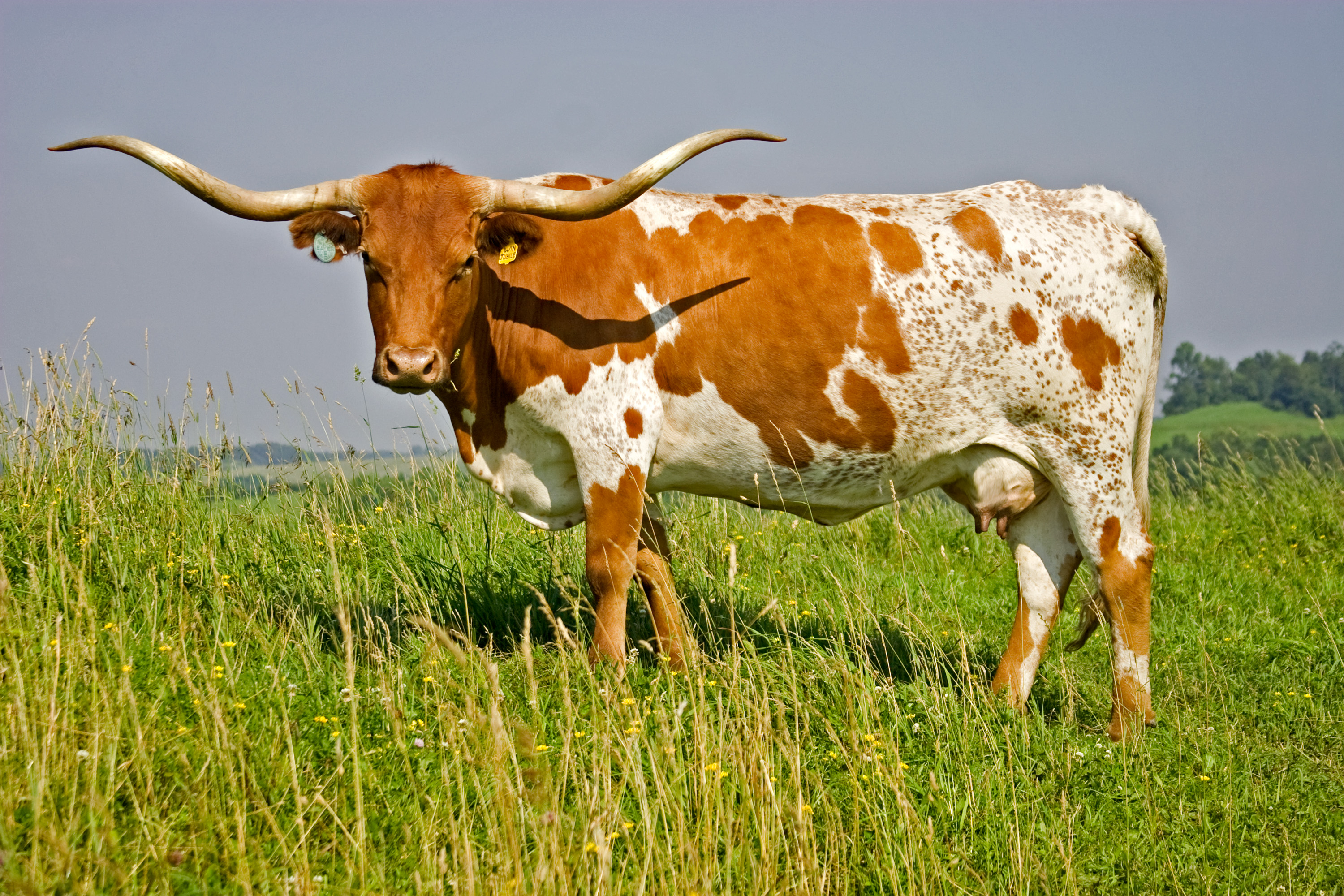
You’re driving through the Texas Hill Country, sun hitting the dusty scrub, and you spot them. A herd of cattle with headgear so wide they look like they’d have trouble fitting through a standard barn door. Your first instinct, if you didn’t grow up on a ranch, is to assume the ones with the massive, sweeping horns are the bulls. It makes sense, right? In most of the animal kingdom, the boys get the flashy ornaments. But when it comes to the question of do female texas longhorns have horns, the answer is a resounding, definitive yes.
They absolutely do.
In fact, if you’re looking at a Longhorn with a truly spectacular, twisty set of horns that span six or seven feet, there’s a statistically high chance you’re looking at a lady. Or a steer. But definitely not always a bull. This is one of those quirks of bovine biology that catches tourists off guard every single year. People expect cows to be "hornless" or "polled," like the sleek black Angus they see in steakhouse commercials. Longhorns don't play by those rules.
The Biology of the Blowout: Why the Ladies Pack Heat
It’s about genetics, not just gender. Both male and female Texas Longhorns carry the genes for horn growth. This isn't like deer where the bucks grow antlers and shed them every year. Horns are permanent. They are living tissue, bone cores covered in a keratin sheath—the same stuff in your fingernails.
From the moment a heifer calf is born, those little nubs are already starting to signal what’s coming. By the time she’s two, she’s sporting a respectable set. By ten? She might be a world-beater.
Hormones play a weird role here. In bulls, testosterone actually makes the horns thicker at the base, but it often stunts the total lateral span compared to what you’d see in a steer or even some cows. The females—the cows—tend to have horns that are more slender. They’re elegant. They often have more "character," which is rancher-speak for twists, turns, and upward swoops that make them look like living art pieces.
Spotting the Difference in the Field
If everyone has horns, how do you tell who’s who? Honestly, don't look at the head. Look underneath.
It sounds primitive, but it’s the only foolproof way. If you see an udder, it’s a cow. If you see... well, the other stuff, it’s a bull. But if you’re trying to judge based on the horns alone, look at the "boss" or the base. Bulls have massive, heavy bases that sit low on the forehead. They look like they’re built for high-impact collisions, which they are.
Do female texas longhorns have horns that look different? Yes. Cow horns usually grow out and then hook upward or backward. Some even do a "corkscrew" move. There’s a famous cow named 3S Danica who became a legend in the breeding world. Her horns didn't just go wide; they had a grace to them that bulls rarely achieve.
Why Evolution Kept the Horns on the Girls
Texas is a tough place. Or at least, it was a lot tougher a few hundred years ago when the ancestors of these cattle were left to fend for themselves. These animals are descendants of Spanish Retinto cattle brought over in the late 1400s and early 1500s. For centuries, they lived feral in the brush.
Imagine being a mother cow in the 1700s in the middle of a mesquite thicket. You’ve got a newborn calf. There are wolves, cougars, and coyotes everywhere. A cow without horns is basically a buffet. A cow with a six-foot span of sharpened keratin is a tank.
The females kept their horns because they had to be the primary protectors. While bulls are off doing bull things, the cows are raising the next generation. Those horns weren't for show; they were for gutting a predator that got too close to a calf. We see the remnants of that "wild" DNA today. Longhorns are famously good mothers. They are protective, alert, and they know exactly where the tips of those horns are at all times. They can swat a fly off their back with the tip of a horn without breaking their stride.
The Record Breakers: It’s a Ladies' Game
If you look at the record books for the Texas Longhorn Breeders Association of America (TLBAA) or the International Texas Longhorn Association (ITLA), you’ll notice something interesting. The "Tip-to-Tip" records are frequently dominated by steers and cows.
Take a look at a cow like Cowboy Tuff Chex. Wait, that’s a bull. But look at the lineage. The reason he’s famous is because of the massive horn genetics passed down from the female side.
There have been cows with horns measuring well over 100 inches tip-to-tip. Think about that. That’s over eight feet of solid bone and keratin. If you put that cow in a standard hallway, she’d be touching both walls.
The "Polled" Myth and Modern Breeding
Some people ask if there are Longhorns without horns. In the industry, "polled" means naturally hornless. While you can find polled cattle in almost every breed, a polled Texas Longhorn is a bit of a contradiction. There are some breeders who have experimented with it, but for the most part, if it doesn't have horns, the registry isn't going to be very interested.
The horns are the brand. They are the identity.
Ranchers like Dickinson Cattle Co. or the owners of the famous central Texas ranches spend decades meticulously pairing cows and bulls to see how the horn shapes will blend. It’s like high-stakes architecture. They look at "base circumference," "total measurement," and "lateral twist."
Caring for a Horned Lady
Owning a cow with a massive rack isn't all sunset photos and glory. It’s logistics.
- Equipment: You can’t use a standard cattle squeeze chute. You’ll snap their horns off. You need specialized "longhorn sweeps" that allow the head to pass through.
- Transport: Loading a cow with a 70-inch span into a 72-inch wide trailer is a geometric nightmare. They have to learn to tilt their heads to get in. Most of them are smart enough to figure it out, but it’s nerve-wracking for the owner.
- Safety: Longhorns are generally docile, especially the females. They’re actually "gentle giants" most of the time. But even a happy cow swinging her head to get a fly can accidentally send you to the ER. You have to learn the "Longhorn bubble."
Cultural Misconceptions: Be the Smart One at the Fair
The media doesn't help. Think about the University of Texas mascot, Bevo. Most people see Bevo and think "Big Strong Bull." Bevo is actually a steer (a castrated male). They use steers because they are generally calmer and their horns grow longer and more impressively for the cameras than a bull’s would.
But if you saw a female out there, she’d look just as "Texas" as Bevo.
The next time you’re at a rodeo or a livestock show and someone points at a cow and says, "Look at that bull!", you can gently correct them. It’s a common mistake, but knowing that do female texas longhorns have horns is a "yes" puts you ahead of about 90% of the general public.
The Economic Value of a Cow's Rack
In the cattle world, most cows are valued by their weight (the "on the hoof" price for beef). Longhorns are different. They are "trophy" animals.
A female Longhorn with exceptional horn length can sell for $10,000, $40,000, or even over $100,000 at elite auctions. Her value isn't in her meat; it’s in her ability to produce calves with that same massive horn potential. The horns themselves are a commodity. After a cow passes away, a high-quality set of polished Longhorn horns can sell for hundreds or even thousands of dollars as home decor.
It’s an industry built on a trait that, in any other breed, would be considered a nuisance.
Summary of Key Takeaways
If you're planning on getting into the breed or just want to be an informed observer, keep these points in mind:
- Both sexes grow horns. It is a primary breed characteristic, not a secondary sex characteristic.
- Female horns are often more "twisty." While bull horns are thicker, cow horns often have more unique shapes and upward curves.
- Horns are for protection. Evolutionarily, the females needed them to defend calves from predators during the centuries they lived feral in the Texas brush.
- Don't judge by the head. If you want to know the sex of a Longhorn, check the udder, not the horns.
- Size matters. Some of the longest horns in history have belonged to females and steers, not bulls.
Actionable Steps for Enthusiasts
If you are interested in seeing these animals up close or perhaps even starting a small "hobby" herd, here is how to move forward:
- Visit a Sanctioned Show: Look for ITLA or TLBAA events. This is the best way to see the difference between bull, cow, and steer horns in person. You'll see the slender elegance of the cows versus the brute thickness of the bulls.
- Check the Registries: If you are buying, always ask for the registration papers. This will give you the "pedigree" of the horns, showing you the measurements of the mother (dam) and father (sire).
- Safety First: If you’re visiting a ranch, never approach a Longhorn from the side. Always stay in their line of sight. Even a cow that likes you can accidentally clip you when she turns her head to look at something else.
- Understand the Space: If you’re thinking of owning one, measure your gates. It sounds silly, but many new owners realize too late that their 4-foot walk-through gate is a "no-go" for a cow with a 5-foot span.
The Texas Longhorn is a testament to survival and a specific kind of rugged beauty. The fact that the females carry such formidable weaponry is just a part of the grit that allowed the breed to survive when others would have vanished. They aren't just "cows with horns"—they are the living history of the American West, and the ladies carry that history just as proudly as the bulls do.