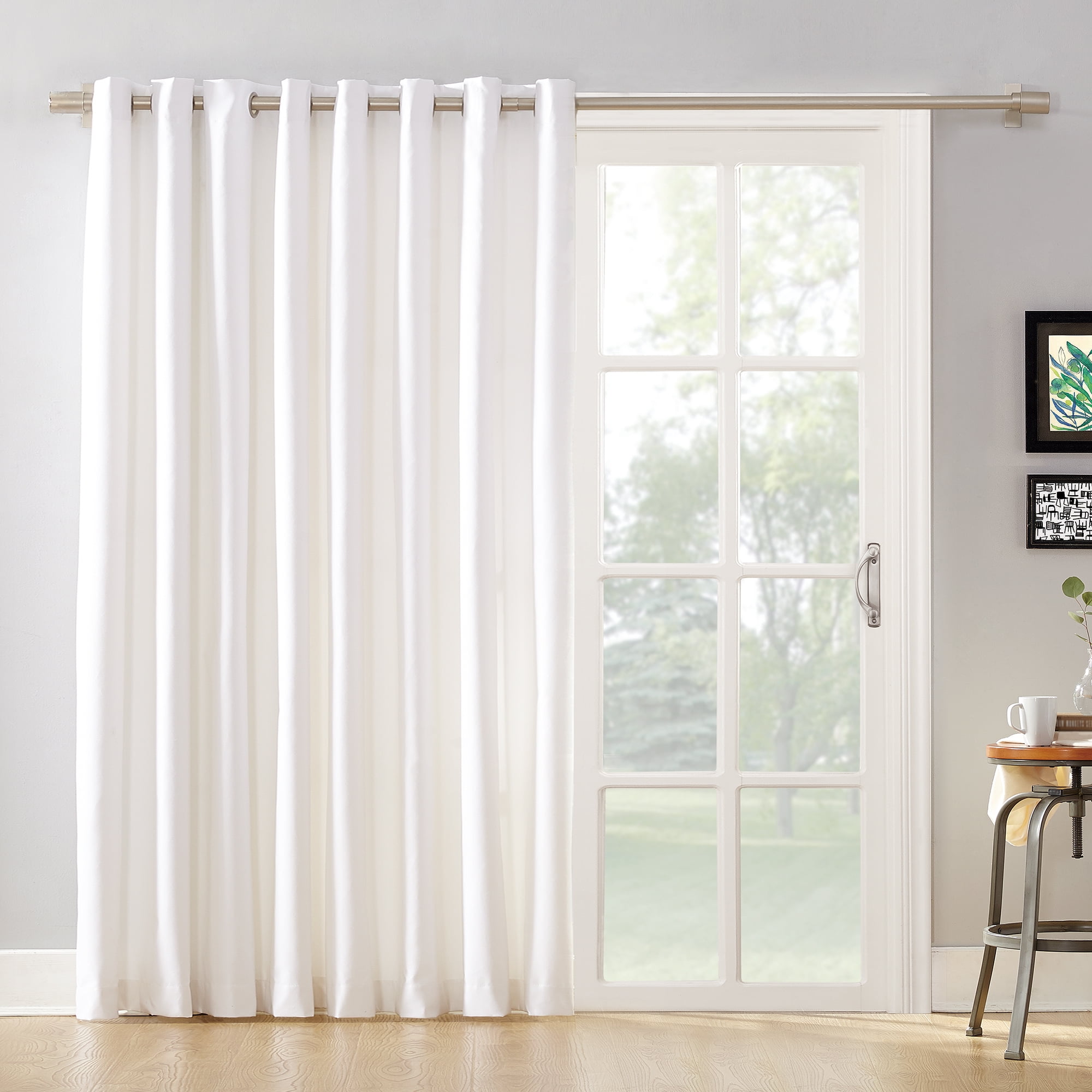
You’ve finally got that massive expanse of glass. It’s gorgeous. The light pours in, the backyard looks like a Pinterest board, and the room feels ten feet wider. Then the sun hits 2:00 PM and your living room turns into a literal oven. Or night falls, and suddenly you feel like you’re living in a fishbowl for the neighbors to see. This is where most people panic-buy the first pair of curtains for sliding glass doors they find at a big-box store, only to realize three days later that they can’t actually open the door without getting tangled in five pounds of velvet.
It’s annoying.
Choosing window treatments for a slider isn't the same as picking them for a standard bedroom window. You’re dealing with a high-traffic zone. It’s a door first and a window second. If your curtains make it hard to let the dog out or carry a tray of burgers to the grill, you’ve failed. Honestly, most homeowners prioritize the "look" and completely forget that sliding doors move horizontally, meaning your fabric needs to play nice with that lateral motion.
The Stack Back Problem Nobody Mentions
Here is the thing: when you open your curtains, the fabric has to go somewhere. This is called the "stack back." If you have a 72-inch wide sliding door and you buy 72 inches of curtain, you’re in trouble. When those curtains are "open," they’ll still be covering about 20% of your glass. It makes the room feel cramped. It blocks the view you paid for.
To avoid this, you need a rod that extends well past the door frame. We're talking 6 to 12 inches on either side. This allows the fabric to bunch up against the wall, leaving the glass entirely clear. Architects often call this "clearing the opening." If you don't have the wall space for that, you might want to reconsider heavy drapes entirely.
Lightweight sheers are a different story. They stack tight. But if you're going for those heavy, thermal-lined blackout curtains for sliding glass doors to keep the summer heat out, that stack is going to be massive. Think about it. A thick fabric with a blackout liner can easily take up 15 inches of horizontal space when pushed aside. If you don't account for that, you'll be squeezing through a narrowed door opening every time you go outside.
Why Grommets Are Probably Your Best Friend (And Why They Aren't)
Grommet tops—those metal rings poked through the fabric—are the default choice for sliders. There’s a reason for that. They slide fast. You can whip them open with one hand while holding a laundry basket. They create those deep, uniform folds that look modern and clean without much effort.
But they have a weakness. Light leaks. Because the rings sit on top of the rod, there is always a gap between the top of the fabric and the rod itself. If you're trying to turn a basement slider into a home theater setup, grommets will betray you. The light will bleed across the ceiling like a flashlight.
For total light control, back-tab or rod-pocket styles are better, but they’re a nightmare to slide. They stick. They bunch. You’ll find yourself tugging at the fabric, which eventually pulls the brackets out of the drywall.
The Traverse Rod Solution
If you want the "luxury hotel" feel, you stop looking at standard rods and start looking at traverse rods. These have a hidden track and a cord (or a motor). You pull a string, and the curtains glide. No tugging on the fabric. No uneven pleats. It’s the most "pro" way to handle curtains for sliding glass doors because it treats the window treatment like a piece of mechanical hardware.
Thermal Reality vs. Marketing Fluff
Let’s talk about energy bills. Glass is a terrible insulator. According to the Department of Energy, about 30% of a home's heating energy is lost through windows, and sliding doors are the biggest culprits. People buy "thermal curtains" thinking it’ll solve everything.
It helps, but only if the seal is tight. If your curtains are hanging two inches off the floor and three inches away from the wall, the "chimney effect" happens. Cold air falls down the glass, hits the floor, and flows right under your curtain into the room.
To actually save money on your AC bill:
- Floor-to-ceiling length is non-negotiable.
- The fabric should "kiss" the floor or even puddle slightly.
- The rod should be mounted as close to the wall as possible.
- Use a "wrap-around" rod that lets the fabric curve back to the wall to seal the edges.
Measuring for the "Perfect" Hang
Measure twice, cry once. Seriously.
Most people measure the door frame. Wrong. You need to measure where the rod is going to live. For a standard 80-inch tall sliding door, you usually want an 84-inch or 96-inch curtain. The 84-inch will sit just above the frame, which looks... okay. It’s fine. But if you want the room to look expensive? Go with the 96-inch. Mount the rod way up high—near the ceiling. It draws the eye upward. It makes your 8-foot ceilings feel like 10-footers.
Width is where the math gets weird. For proper "fullness," your curtains should be 2 to 2.5 times the width of the area you’re covering. If your door and the extra wall space total 100 inches, you need 200 to 250 inches of fabric width. If you just buy 100 inches of fabric, when you close the curtains, they’ll be stretched flat like a sheet. It looks cheap. It looks like an afterthought.
Fabric Choices: The Sun Will Destroy Your Silk
Natural silk is beautiful. It’s also doomed. If your sliding door faces south or west, the UV rays will eat natural fibers for breakfast. Within two years, your expensive silk drapes will literally shred if you poke them.
For high-sun areas, polyester blends are actually superior. Modern "linen-look" polys are incredible now. They have the slubby, organic texture of real linen but won't yellow or get brittle in the sun. If you absolutely must have 100% natural fibers, you have to invest in a high-quality UV-rated lining. It’s an extra layer of protection that acts as a sacrificial lamb for the sun.
Maintenance and the "Dirty Hem" Problem
Sliding doors are portals to the outside. That means dirt, pollen, and dog hair. Because these curtains are floor-length, the bottom six inches act like a giant Swiffer.
If you have kids or pets, stay away from white velvet. Just don't do it to yourself. Look for performance fabrics or outdoor-rated acrylics (like Sunbrella) that can be spot-cleaned with a damp cloth. Also, consider the "flick" factor. Every time someone walks out that door, they’re going to touch the edge of that curtain. Over time, skin oils leave a dark smudge at hand-height. Choosing a fabric with a bit of a pattern or a darker tone can hide a lot of sins.
The One-Way Draw vs. Center Split
Most people naturally go for a center split—two panels that meet in the middle. But look at your door. Which way does it slide? If it’s a "right-hand" slide, where the left side is fixed and the right side moves, a center split might be annoying. You’ll have a pile of fabric right in the middle of your walking path.
A "one-way draw" (one giant panel that all slides to one side) is often the smarter move. It keeps the fabric entirely on the "fixed" side of the door. When you want to go out, the path is totally clear. No fabric flapping in the wind or getting caught in the screen door track.
Real Talk on Privacy
Sheers are great for daytime. They let the light in and stop the neighbors from seeing what you’re eating for lunch. But at night, with the lights on inside? They’re basically transparent.
The "double rod" setup is the gold standard here. You have a sheer layer for the day and a heavy blackout layer for the night. Yes, it’s more expensive. Yes, it’s a bit bulkier. But it gives you total control over your environment. If you're on a budget, you can find "dim-out" curtains—which are a middle ground—but they don't quite offer the airy feel of a true sheer.
Practical Next Steps
Before you click "buy" on those curtains for sliding glass doors, do these three things:
- Check your clearance: Measure the distance from the top of the door frame to the ceiling. If it’s less than 6 inches, you might need a ceiling-mounted track instead of a wall-mounted rod.
- Test the "Wand" idea: If you hate touching the fabric, buy a 36-inch clear acrylic baton (a wand). You clip it to the first ring, and you use that to pull the curtains. It keeps the fabric clean and feels very high-end.
- Confirm your "Stack": Use a piece of blue painter's tape on the wall to mark where the curtains will sit when open. Does it cover the light switch? Does it hit a bookshelf? Better to know now than after you’ve drilled holes in the wall.
Stop thinking of these as just "big curtains." They are a functional part of your home's entry and exit system. Get the hardware right first, and the style will follow.