You’re sitting in a coffee shop in Seattle or maybe a home office in San Francisco, and your laptop says it's almost 9am. You have a Zoom call with a client in London. Or maybe you're a gamer waiting for a patch to drop. You think you know the math. You’ve done it a thousand times. But then you realize you aren't sure if the UK is on Summer Time or if the US just moved their clocks forward last Sunday.
It’s stressful. Honestly, time zones are a bit of a nightmare for anyone working globally.
When you convert 9am PT to UK time, the standard answer is 5pm. It’s an eight-hour gap. Most of the year, this rule holds firm. But because the US and the UK can’t seem to agree on when to change their clocks for Daylight Saving Time (DST), that eight-hour gap occasionally shrinks to seven. If you get it wrong, you’re either an hour late to a high-stakes board meeting or sitting in an empty virtual lobby wondering where everyone is.
The Basic Math of the Eight-Hour Jump
Pacific Time (PT) generally refers to either Pacific Standard Time (PST), which is UTC-8, or Pacific Daylight Time (PDT), which is UTC-7. Across the pond, the UK alternates between Greenwich Mean Time (GMT) and British Summer Time (BST).
Here is how the 9am PT to UK time conversion usually breaks down:
- During the winter months, when both regions are on standard time, 9am PST becomes 5pm GMT.
- During the summer, when both are on "Daylight" or "Summer" time, 9am PDT becomes 5pm BST.
It feels consistent. It feels safe. But it’s the transition periods in March and October that ruin people’s schedules.
The US typically kicks off Daylight Saving Time on the second Sunday in March. The UK, following the European schedule, usually waits until the last Sunday in March. For those two or three weeks in the spring, the gap is only seven hours. In that specific window, 9am PT is actually 4pm in London. If you show up at 5pm, you’ve missed the party.
Why Does the UK Use BST?
British Summer Time was first established by the Summer Time Act 1916. It wasn't just a random idea; it was actually a response to the need to save fuel during World War I by using more natural light.
A builder named William Willett is often credited with the idea. He spent years campaigning for it because he was annoyed that people slept through the best part of a summer morning. He’d be riding his horse through Chislehurst at 6am and seeing all the shutters closed. He actually wanted to move the clocks by 20 minutes every Sunday in April, which sounds like an absolute logistical disaster by modern standards. Thankfully, they settled on a clean hour.
When the UK is on BST, they are at UTC+1. When they are on GMT, they are at UTC+0.
The Logistics of a 9am PT Start
If you are a business owner in California, 9am is the sweet spot. It’s when the second cup of coffee hits. It’s when the team is finally settled. But for your UK counterparts, 5pm is the "danger zone."
At 5pm in London, people are looking at the door. They are thinking about the Tube ride home or what to cook for dinner. Scheduling a 9am PT meeting means you are catching the UK workforce at the very tail end of their day. It’s often the last thing they do before logging off.
Some companies, like GitLab or Automattic, which are famous for being "remote-first" and asynchronous, try to avoid these overlaps entirely. They use tools like Threads or Slack to let people communicate without needing to be awake at the same time. But for most of us, the 9am PT to UK time sync is a daily reality.
Real World Example: The Tech Industry Sync
Silicon Valley lives on Pacific Time. London is the fintech capital of Europe. When a VC firm in Palo Alto wants to talk to a startup in Shoreditch, 9am PT is the standard compromise.
I remember a specific instance during a product launch in 2023. The engineering team was in San Francisco, and the marketing lead was in London. They had a "hard sync" at 9am PT every Tuesday. It worked great until the US moved their clocks forward in March. The SF team showed up at 9am, assuming it was still 5pm in London. But because the UK hadn't shifted yet, the London lead was already halfway through a dinner reservation because it was 4pm for them when the meeting was supposed to happen—but the calendar invite, which was anchored to PT, shifted it to 4pm London time.
Confusing? Totally.
This is why "calendar math" is a legitimate skill. Most modern calendars like Google or Outlook handle the shift automatically, but only if you have the "Time Zone" for the event set correctly. If you manually type "5pm" into a description, you’re asking for trouble.
The Impact on Global Gaming and Entertainment
It isn't just about business. If a movie trailer drops at 9am PT, fans in the UK are refreshing their feeds at 5pm.
Gaming is perhaps the biggest driver of these searches. When Activision or Blizzard announces a 9am PT launch for a new season of Call of Duty or World of Warcraft, the UK player base knows they have to wait until the evening. It’s actually a bit of a benefit for the Brits. While the Californians are trying to play during their work hours (don't tell the boss), the UK players are just finishing work and sitting down with a beer.
Daylight Saving Time: Is It Going Away?
There has been a massive push in both the US and the UK to stop the "clock switching" entirely. In the US, the Sunshine Protection Act has been floating around Congress for a while. The idea is to make Daylight Saving Time permanent.
If that happened, we wouldn't fall back in November.
The UK has had similar debates. Between 1968 and 1971, they actually did a trial where they stayed on BST all year round. It was called the British Standard Time experiment. It was generally popular in the south, but people in Scotland hated it because the sun didn't rise until nearly 10am in the winter. Imagine kids walking to school in pitch-black darkness. Because of that, they went back to the old system.
As of 2026, the status quo remains. We still do the dance twice a year.
Managing the Gap: Expert Tips for 9am PT to UK Time
If you’re managing teams or just trying to call your grandmother in Manchester, don't rely on your brain to do the math during those weird "bridge" weeks in March and October.
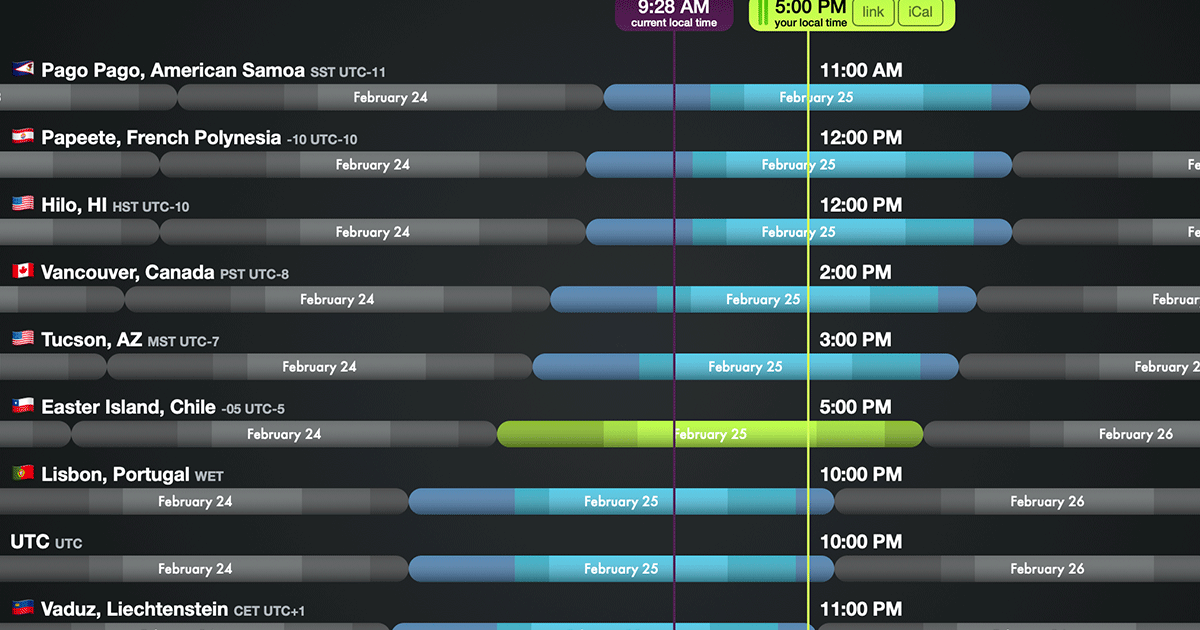
- Use World Time Buddy. It’s a simple site that lets you overlay time zones. It’s much more visual than just a digital clock.
- Anchor your meetings to UTC. If you say "The meeting is at 16:00 UTC," there is zero ambiguity. Everyone has to figure out their own offset from a fixed point.
- Double-check the "Bridge" weeks. Mark your calendar for the second Sunday in March and the last Sunday in March. That is the period where the 8-hour gap becomes 7.
- Assume 5pm, but verify. 9am PT to UK time is 5pm about 92% of the year.
The Human Element of Time Zones
Working across these zones is exhausting. If you're on the PT side, you feel like you have to wake up early to catch the end of the European day. If you're in the UK, you feel like your workday never ends because the "Americans are waking up" just as you want to wind down.
There’s a psychological weight to it. When it’s 9am in Los Angeles, the sun is often bright and the day feels full of potential. In London, at 5pm in November, it’s already dark. The energy levels are completely different. That’s something a clock doesn't tell you. When you hop on that 9am PT call, remember your UK colleague has likely been working for eight hours already. They are tired. You are just starting.
Actionable Steps for Scheduling
To make sure you never mess up the 9am PT to UK time conversion, follow these specific steps:
- Check the current month: If it is March or October/November, stop and Google "current time in London" specifically. Do not trust your memory.
- Set your secondary clock: Most Windows and Mac laptops allow you to show two clocks in the taskbar. Set the second one to London (GMT/BST).
- Communication is key: When sending an invite, write it as "9am PT / 5pm UK." This allows the recipient to immediately flag if their calendar shows something different.
- Buffer your meetings: Avoid scheduling "hard stops" at 10am PT (6pm UK) if possible. Your UK team will appreciate not having to work overtime just because the time zone shift is inconvenient.
The transition from 9am PT to UK time is a pillar of the global economy, but it requires a bit of vigilance. Stay aware of those March and October shifts, and you'll stay on everyone's good side.