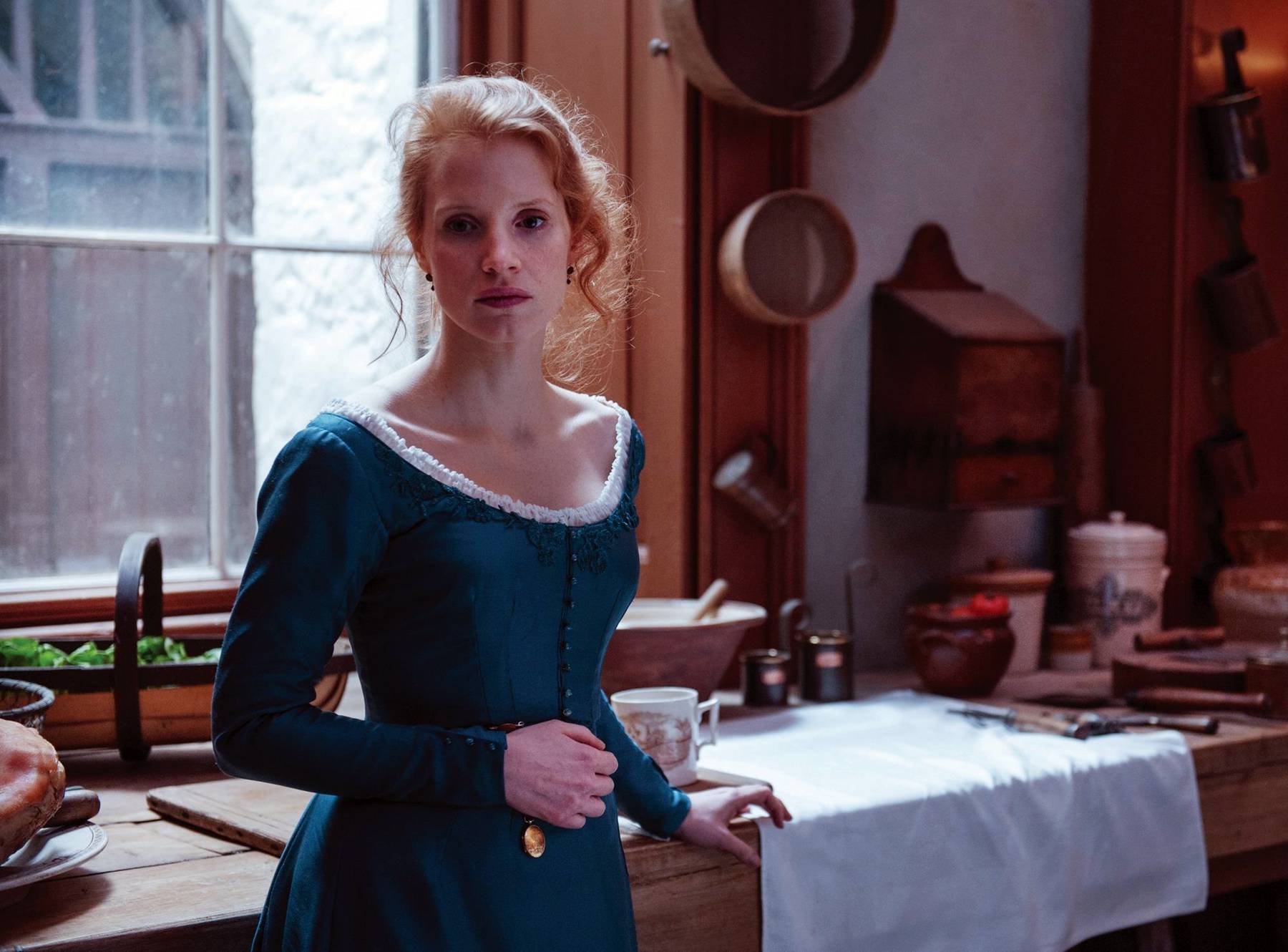
Honestly, if you ask the average moviegoer about Colin Farrell's "pre-renaissance" period, they usually jump straight to the flashy stuff. People talk about the big hits or the cult classics, but there is this one weirdly intense project from 2014 that almost everyone ignores. It's called Miss Julie.
Directed by the legendary Liv Ullmann—Bergman’s muse, no less—it stars Farrell alongside Jessica Chastain and Samantha Morton. On paper, that is a powerhouse lineup. Yet, when it came out, it kinda vanished. It didn't have the backing of a major studio machine, and let's be real, a two-hour-plus period drama based on an 1888 Swedish play isn't exactly "popcorn" material.
But if you look back at it now, you’ve basically got a masterclass in raw, uncomfortable acting. Farrell isn't playing a hero here. He isn't even really playing a "likable" guy. He plays John, a valet who is caught in a toxic, class-warfare-fueled spiral with the daughter of his employer.
What Really Happens in the Movie?
The setup is deceptively simple. It is Midsummer’s Eve in 1890, County Fermanagh, Northern Ireland. While the rest of the staff is out partying, John (Farrell) is stuck in the kitchen with Kathleen (Samantha Morton), the cook who is also his fiancée. Then comes Miss Julie (Chastain).
She is the aristocrat. He is the help.
What follows is this claustrophobic, sweaty, and deeply psychological power struggle. Miss Julie is bored and self-destructive; John is ambitious and resentful. They flirt, they fight, and they eventually cross a line that, in the 19th century, was essentially a social death sentence.
Why Colin Farrell’s Role is So Divisive
In most of his roles, Farrell has this natural "charismatic rogue" energy. You want to like him even when he’s being a jerk. In Miss Julie, he strips a lot of that away.
John is a complicated mess. One minute he is polished and subservient, speaking with a refined diction he’s clearly practiced to mimic his "betters." The next, his thick Irish brogue slips back in as he reveals his deep-seated anger toward the upper class.
Critics at the time were split. Some, like the folks at Reverse Shot, argued that Farrell had "never been better," noting how he could switch from "lion to weasel" in a single scene. Others found the whole thing a bit too "theatrical."
That’s the thing about this movie: it feels like a play. It was shot almost entirely at Castle Coole in Northern Ireland, mostly in a basement kitchen. It’s meant to feel airless. It’s meant to make you feel as trapped as the characters are.
The Dynamic With Jessica Chastain
The chemistry—if you can even call it that—between Farrell and Chastain is more like a chemical reaction that's about to blow up a lab. It isn't romantic. It is predatory on both sides.
Julie uses her status to devalue John, literally making him kiss her boots at one point. John uses his masculinity and Julie’s own desperation to gain the upper hand. Watching them go at it is exhausting.
- They start with a playful, dangerous flirtation.
- The power shift happens the moment they actually sleep together.
- The aftermath is a brutal realization that they have no future.
It's grim. Really grim. But Farrell’s performance is fascinating because he avoids making John a one-dimensional villain. You see the "arriviste" fantasies—his dream of owning a hotel in Italy—and you realize he’s just as much a victim of the class system as Julie is, even if his response to it is more calculated.
Behind the Scenes: The Castle Coole Factor
Originally, the production was supposed to shoot interiors on a soundstage in Germany. Money got tight. Budgetary issues actually forced Liv Ullmann to shoot the whole thing on location at Castle Coole.
This ended up being a blessing. The kitchen where most of the movie takes place was actually underground, surrounded by white stone walls. This physical reality helped the actors. There was no "outside" to look at—just the feeling of being buried alive in a house that didn't belong to them.
Farrell was actually the last person cast. He joined in early 2013, right before they spent two weeks just rehearsing on-site. You don't get that kind of prep time on a Marvel set. It shows in the way they move through the space. They know the corners of that kitchen. They know where the shadows are.
Is It Worth Watching Now?
Look, if you hate "stagy" movies where people talk for two hours, you’re gonna have a bad time.
But if you’re a fan of Farrell’s later work in things like The Banshees of Inisherin or The Lobster, you need to see this. It’s the bridge between his "Hollywood leading man" days and the "prestige character actor" era he’s in now.
He isn't afraid to look pathetic. He isn't afraid to be cruel.
The film currently sits at a mediocre 53% on Rotten Tomatoes, which is honestly a bit of a crime. It’s a movie that demands a lot from the viewer. It asks you to sit with some very ugly human emotions for a very long time.
Actionable Takeaway for Film Fans
If you want to actually appreciate what Farrell is doing here, do these three things:
- Watch for the accent shifts: Notice how John changes his voice depending on whether he’s trying to impress Julie or berate her. It’s a subtle piece of character work.
- Pay attention to Samantha Morton: She’s the "moral anchor" in the kitchen, and her silent reactions to the chaos are just as good as the leads' big speeches.
- Compare it to the play: If you’re a nerd for literature, read August Strindberg’s original text. Ullmann changed the setting to Ireland to make the class conflict feel more immediate for an English-speaking audience, and it totally changes the "vibe" of the piece.
Don't go into it expecting a romance. It’s a tragedy about how people destroy each other when they’re trapped by the rules of a society that doesn't want them to change. It’s dark, it’s weird, and it’s one of the most underrated entries in Colin Farrell’s filmography.
To get the most out of the experience, seek out the director’s cut or the versions that include the "bookend" scenes of Julie as a child. They provide a lot of context for why she is so broken by the time she meets John in that kitchen.