So, you’re headed to the land of Pablo Neruda, world-class Cabernet, and the jagged peaks of Patagonia. You’ve probably already looked at the maps and maybe even picked out a puffy jacket for the south. But then you hit that classic logistical wall: what is the currency for chile, and how does it actually work in the real world?
Honestly, it’s a bit of a trip. If you’re coming from the US or Europe, the numbers are going to look absolutely wild. You’ll walk into a corner shop for a bottle of water and see a price tag of $1.500. Don't panic. You aren't paying fifteen hundred dollars for hydration. That little "$" sign isn’t for US dollars—it’s the symbol for the Chilean Peso (CLP).
The Basics: Getting Your Head Around the Numbers
The Chilean Peso is the official and only currency you’ll use for day-to-day life. While some high-end hotels in Santiago or luxury lodges in Torres del Paine might quote prices in USD to make it easier for international guests, you’ll be paying for your empanadas, bus tickets, and museum entries in pesos.
The ISO code is CLP. If you’re checking exchange rates on an app like Wise or XE, that’s what you’ll type in.
Currently, in early 2026, the exchange rate has been hovering around 900 to 1,000 pesos per 1 US Dollar.
Think about that for a second. It means a 10,000 peso bill—which feels like a massive amount of money when you’re holding it—is actually worth roughly 10 or 11 bucks. It takes some mental gymnastics to get used to all those zeros. I usually tell people to just "drop the three zeros" and you’ve got a rough ballpark of the value in USD, though with the current 2026 rates, it’s actually a bit stronger than a 1:1 ratio.
Banknotes and "The Hero" on Your Cash
Chilean bills are actually pretty cool. They aren't just paper; the lower denominations are made of a polymer plastic that’s hard to tear and survives a trip through the washing machine.
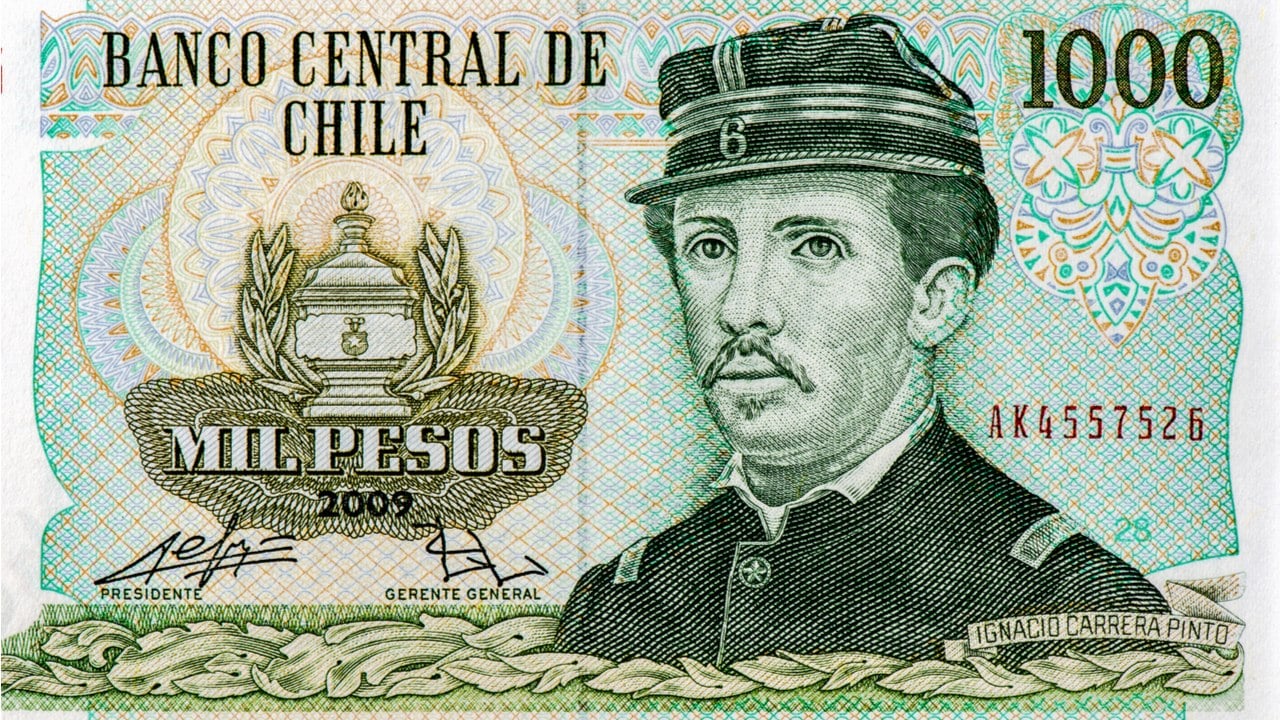
- 1,000 pesos: Often called a "Luca" by locals. It features Ignacio Carrera Pinto.
- 2,000 pesos: This one is a distinct red/purple color.
- 5,000 pesos: Look for Gabriela Mistral, the famous poet. Locals sometimes call this a "Gabriela."
- 10,000 pesos: The blue one. It features Arturo Prat.
- 20,000 pesos: The orange-ish heavy hitter. Andres Bello is the face here.
If you hear someone say, "That costs two Lucas," they just mean 2,000 pesos. It’s the most common slang you’ll encounter.
What Happened to the Centavos?
You might see "centavos" mentioned in old textbooks or deep-dive economic reports. Forget them. Inflation in the late 20th century basically deleted the centavo from existence. In 1996, the government formally eliminated the subdivision.
Nowadays, even the 1 and 5 peso coins are basically museum pieces. While they are technically legal tender, the Central Bank stopped minting them years ago. Most retailers use a rounding rule. If your total ends in 1 through 5, it rounds down to the nearest 10. If it ends in 6 through 9, it rounds up. It’s efficient, it’s fast, and it means you won't end up with a pocket full of worthless copper.
Using Cash vs. Plastic in 2026
Chile is surprisingly high-tech when it comes to payments. You can tap your phone or use a contactless credit card in almost every Starbucks, supermarket, or pharmacy in Santiago.
But Chile isn't just Santiago.
If you’re heading to the "Ferias" (local markets) to buy fresh chirimoya or wandering through a tiny village in the Elqui Valley, cash is still king. Small "Almacenes" (corner stores) often have a minimum spend for card use, usually around 2,000 or 3,000 pesos.
Pro Tip on the 19% Tax:
Here is a weird quirk about the currency for chile that most people miss. If you are a foreign tourist, you can actually get an exemption on the 19% IVA (VAT) tax on hotel stays. But there’s a catch: you usually have to pay in US Dollars (cash) or with a foreign credit card. If you pay in Chilean Peso cash, the hotel is legally required to charge you that 19% tax. It’s one of the few times when using the local currency actually costs you more.
Where to Get Pesos (and Where Not To)
Don't buy your pesos at your home bank before you leave. The rates are usually garbage.
When you land at Santiago Airport (SCL), you'll see currency exchange booths (Casas de Cambio) right near the luggage carousels. Keep walking. Their rates are notoriously bad. If you absolutely need cash for a taxi, just change 20 bucks or use an ATM.
The best way to get the currency for chile is:
- ATMs (Redbanc): They are everywhere. Look for the maroon and white "Redbanc" logo. Be aware that Chilean banks charge a "usage fee" for foreign cards, often between 5,000 and 8,000 pesos per withdrawal ($6-$9 USD). Banco Estado and Scotiabank sometimes have lower fees, but it varies.
- Casas de Cambio in the City: If you have crisp, clean USD or Euro bills, head to Calle Agustinas in downtown Santiago. It’s the hub for money exchange, and the competition keeps the rates tight.
A Note on Tipping
Tipping (the "Propina") is standard but not aggressive. In restaurants, the waiter will usually ask, "¿Desea agregar la propina?" (Do you want to add the tip?). This is almost always a flat 10% added to the bill. You can say yes and pay it via card. For hotel porters or tour guides, having a few 1,000 peso notes handy is the way to go.
Summary Checklist for Your Trip
- Notify your bank: Chile is safe, but sudden foreign transactions can trigger a freeze.
- Carry small bills: Breaking a 20,000 peso note in a taxi or a small cafe is a nightmare. Try to keep 1,000s and 2,000s on you.
- Watch for the symbol: Remember, $ means Pesos here. If a menu says $12.000, it’s about twelve dollars, not twelve thousand dollars.
- Keep your "PDI" paper: When you enter Chile, they give you a small thermal paper receipt (the Tourist Card). Keep this with your passport! You need it to get that 19% tax discount at hotels.
Chile is an incredible country, and once you get past the "sticker shock" of seeing million-peso prices for high-end items, the currency is very easy to manage. Just keep a conversion app on your phone and remember the rounding rule.
To prepare for your trip, check your bank's international ATM fee policy today. Knowing if you'll be charged $5 or $0 per withdrawal will help you decide whether to take out large sums of pesos at once or withdraw as you go.