Let’s be honest for a second. When Tim Burton decided to tackle characters from Alice in Wonderland movie back in 2010, he wasn't exactly aiming for a faithful page-to-screen adaptation of Lewis Carroll’s 1865 masterpiece. He went for a fever dream. If you grew up with the 1951 Disney cartoon, the live-action versions—both the 2010 hit and its 2016 sequel, Through the Looking Glass—probably felt like a bit of a shock to the system.
Johnny Depp’s eyes were too big. Helena Bonham Carter’s head was massive. It was a lot to take in.
But beneath all that CGI and the heavy white face paint, there’s actually a ton of literary history and specific design choices that explain why these versions of the characters feel so different. They aren't just wacky for the sake of being wacky. Well, mostly.
The Problem With Alice Herself
Mia Wasikowska plays Alice Kingsleigh, but she isn't the seven-year-old girl from the books. In the movie, she’s nineteen. This was a huge gamble because it changed the entire vibe of the story from a child’s nonsensical exploration to a young woman’s struggle with Victorian societal expectations.
Alice is basically a rebel in a corset. She’s grieving her father, dodging a marriage proposal from a guy with serious digestive issues, and falling down a rabbit hole—literally. Critics like Roger Ebert pointed out that this version of Alice is more of an "action hero" than a dreamer. She has to slay the Jabberwocky, which is a far cry from the book where she mostly just argues with flowers and gets confused by cats. Wasikowska plays her with this sort of stoic, almost detached curiosity. It’s a polarizing choice. Some people find it boring; others think it’s the only way a sane person would react to a world where caterpillars smoke hookahs.
Johnny Depp and the Mad Hatter’s Real History
The Tarrant Hightopp version of the Mad Hatter is... polarizing. Depp took the "mad" part very literally.
Did you know "mad as a hatter" wasn't just a fun rhyme? It was a real medical condition. Hatters in the 18th and 19th centuries used mercury to process felt. They breathed in the fumes for years, which led to mercury poisoning. Symptoms included tremors, irritability, and hallucinations. Depp and Burton used this as the foundation for the character. That’s why his skin has those strange patches and his hair is that vivid, burnt orange. It’s supposed to look like chemical damage.
In the film, the Hatter is the emotional core. He’s suffering from what looks like severe PTSD. His mood swings are violent. One minute he’s charming and reciting the "Jabberwocky" poem, and the next his voice drops three octaves and he’s talking in a thick Scottish accent. This happens because the movie treats Wonderland (or "Underland") as a real place that was traumatized by war. The Hatter isn't just eccentric; he’s a survivor.
The Red Queen vs. The Queen of Hearts
This is where things get confusing for casual fans. In the movies, Helena Bonham Carter plays Iracebeth of Crims. She’s a mashup. In Carroll’s books, the Queen of Hearts (from Alice's Adventures in Wonderland) and the Red Queen (from Through the Looking Glass) are two completely different people.
The Queen of Hearts is a "blind fury," while the Red Queen is more like a cold, disciplined chess piece.
Burton just smashed them together.
Iracebeth has the "Off with their heads!" catchphrase of the Hearts queen but the royal status of the Red Queen. Her design is iconic—that bulbous, oversized head. It wasn't just for a laugh. It represents her ego and her instability. The production team used a specialized dual-camera rig to capture Bonham Carter’s performance so they could blow her head up to twice its size in post-production without losing the detail of her expressions. She’s a bully, sure, but the sequel actually tries to make us feel sorry for her by revealing her sister, the White Queen, was kind of a jerk to her when they were kids. It’s a weirdly domestic drama for a movie about talking animals.
The White Queen’s Dark Side
Anne Hathaway’s Mirana is... unsettling. She walks with her hands held up like she’s constantly afraid of touching something dirty. Hathaway has said in interviews that she based the White Queen on a "punk-rock vegan pacifist."
She looks like a porcelain doll, but there’s a darkness there.
She won't kill, but she’s happy to let Alice do the killing for her. She makes a potion out of dead fingers and spit. It’s a great example of how the characters from Alice in Wonderland movie subvert the idea of "good" and "evil." Mirana is the "good" sister, but she’s just as eccentric and perhaps a bit more manipulative than her big-headed sibling.
The Animals: CGI With a Soul
We have to talk about the Cheshire Cat. Voiced by the legendary Stephen Fry, this version of Chessur is less of a prankster and more of a cynical guide. The fur looks incredible, but it’s the eyes that sell it. Those big, glowing turquoise orbs. In the books, he’s an agent of chaos. In the movie, he’s a bit of a coward who eventually finds his courage.
Then there’s Absolem the Caterpillar, voiced by Alan Rickman in his final film role.
Rickman’s voice is perfect for a creature that is perpetually unimpressed by everyone around him. The transformation from the blue caterpillar to the butterfly in the second movie is one of the few moments that actually feels like it captures the "spirit" of the original books—transformation, the loss of childhood, and the inevitability of change.
The supporting cast is a who's who of British acting royalty:
- Michael Sheen as the White Rabbit (Nivins McTwisp)
- Timothy Spall as Bayard the Bloodhound
- Barbara Windsor as the Dormouse (Mallymkun)
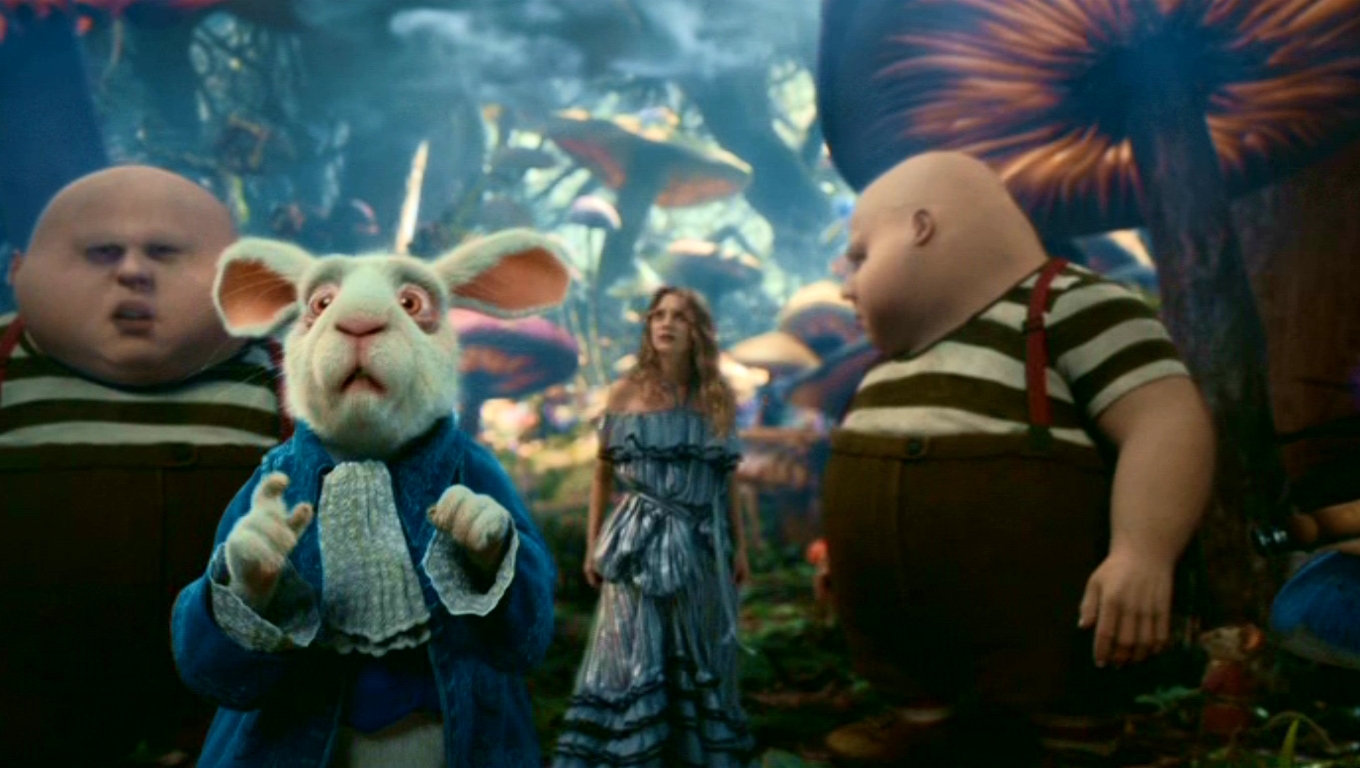
- Matt Lucas playing both Tweedledee and Tweedledum
The Tweedles are particularly creepy. They look like giant, pale toddlers. Using a single actor for both and then digitally altering the proportions creates this "uncanny valley" effect that fits Burton's aesthetic but might give younger kids nightmares.
Why the Design Matters
The costumes, designed by Colleen Atwood, won an Oscar. They should have. The way the characters from Alice in Wonderland movie change their outfits as they change size is a detail most people miss. Alice’s clothes are constantly being repurposed from whatever fabric is lying around—the Red Queen’s curtains, for instance—because her original dress doesn't grow and shrink with her.
This grounded the fantasy in a bit of "Underland" logic.
If you’re looking to understand these characters, you have to look at the colors. The Red Queen’s court is all garish reds and blacks, representing obsession and blood. The White Queen’s world is sterile, blindingly white, and almost too perfect to be trusted. The Hatter is a mess of every color, reflecting his shattered mind.
Real-World Impact and Misconceptions
One of the biggest misconceptions is that these movies are for kids. I mean, they are Disney movies, but they are dark. The 2010 film deals with the death of a parent and the pressure of a forced marriage. The 2016 sequel, Through the Looking Glass, is literally about the "theft" of time and the trauma of a broken family.
Critics often argue that by giving these characters backstories, the movies ruin the "nonsense" of the original books. Lewis Carroll wrote a world without logic. Tim Burton gave it a plot. Whether you like that or not usually depends on whether you prefer your fantasy to be a puzzle or a journey.
How to Dive Deeper Into Wonderland
If you’re a fan of these versions of the characters, don't stop at the movies. To truly appreciate what the actors were doing, you should check out the concept art books by Mark Salisbury. They show the early sketches of the Mad Hatter that are even more grotesque than what made it onto the screen.
Also, if you want a different perspective, read the original 1865 text. You’ll notice that the movie characters are much more "humanized" than Carroll’s creations. In the book, the Mad Hatter is just a guy who is literally stuck at tea time because he "murdered the time" while singing for the Queen. The movie turns that into a tragic history, but the book leaves it as a weird, unexplained curse.
Practical Steps for Fans
- Compare the versions: Watch the 1951 animated version followed by the 2010 live-action film. Note how the character of the March Hare changes from a frantic lunatic to a slightly more menacing, dish-throwing manic-depressive.
- Research the "Victorian Nonsense" genre: To understand why Alice acts so weird, look up the literary movement Lewis Carroll belonged to. It helps explain why the dialogue feels like a series of riddles.
- Check out the costumes: Look at Colleen Atwood’s design sketches. They reveal a lot about the characters' motivations that isn't explicitly said in the script.
Wonderland isn't supposed to make sense. But in the movies, the characters are trying their best to survive a world that has stopped making sense to them. That’s a very different, and much more modern, take on a classic. Over a century later, we’re still obsessed with these characters because they represent the parts of ourselves we’re afraid to show—our madness, our anger, and our desire to just disappear like a cat into thin air.