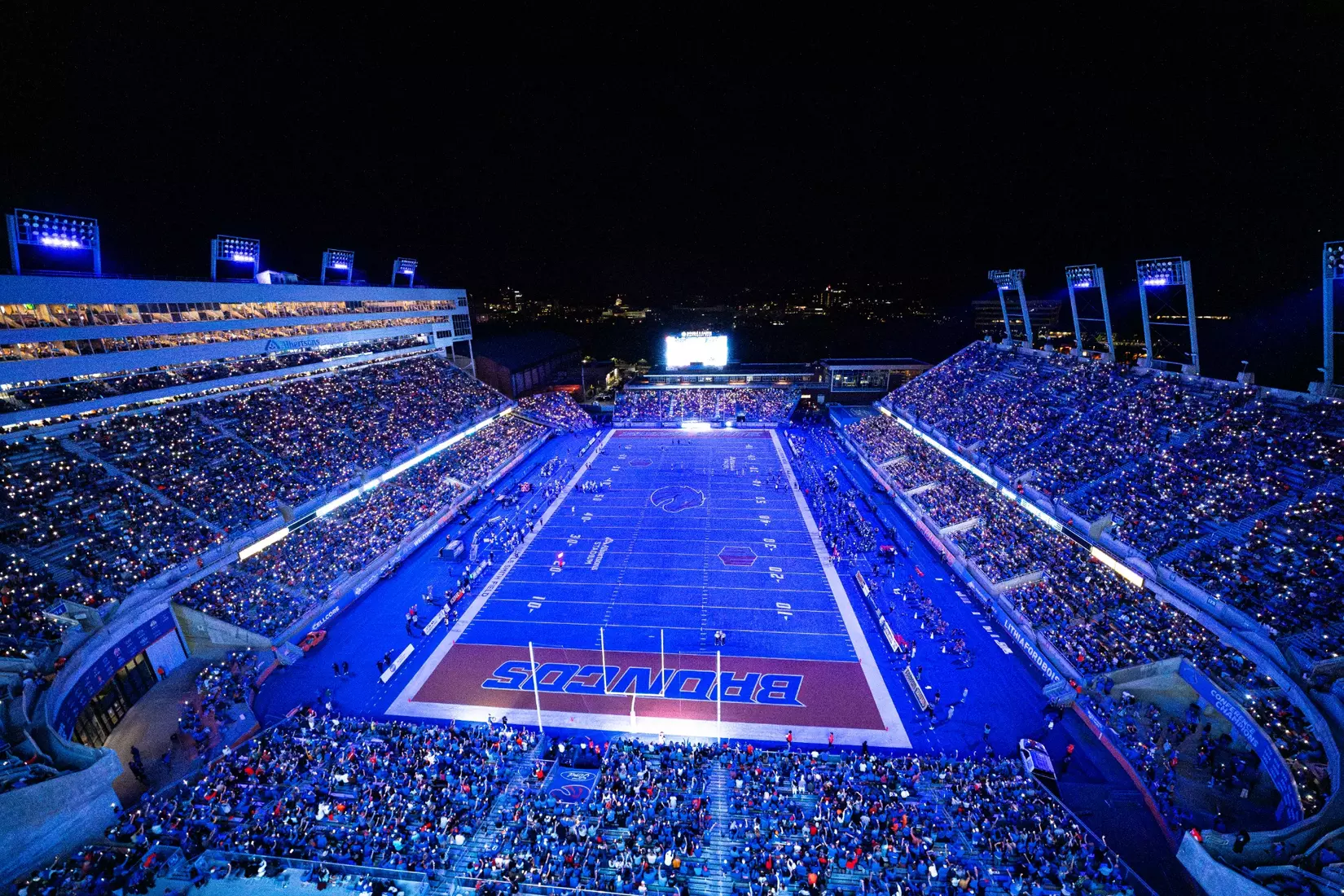
It is a weird sight if you aren't ready for it. You’re driving through a relatively quiet part of Idaho, and suddenly, there it is: a giant, shimmering slab of Smurf-blue plastic in the middle of a concrete bowl.
Most people call it "The Blue." Officially, it’s Lyle Smith Field at Albertsons Stadium. But to the rest of the college football world, the Boise State Broncos stadium is that place with the "eye-burning" field.
Honestly, when Gene Bleymaier first pitched the idea back in 1986, people thought he was losing it. He was the Athletic Director at the time, and the school needed to replace the old, worn-out green AstroTurf. Bleymaier was on a flight, looking down at the stadium, and it hit him. Why spend $750,000 on a new green carpet when nobody would even notice the difference?
"I might be crazy, but I'm not stupid," he famously said when people asked why he didn't go with an orange field instead. Blue was the school color. It was bold. It was, frankly, a massive marketing gamble that shouldn't have worked.
The 2026 Face-Lift and the Move to the Pac-12
If you haven't been to Boise lately, the place looks like a construction zone. That’s because the Boise State Broncos stadium is undergoing its most significant transformation in decades. We’re talking about a $65 million North End Zone project that is literally changing the way fans experience a Saturday in Idaho.
Shovels hit the ground in January 2025. By the time the 2026 season kicks off—which, by the way, is Boise State's massive debut year in the rebuilt Pac-12—the stadium will be a completely different beast.
Here is what is actually happening with the renovation:
- They’re adding 12 field-level suites where you can basically trip over the players.
- The "North End Zone Project" is connecting the east and west stands with a 360-degree concourse. No more getting stuck in a dead-end walkway.
- There’s a new "Ledge" seating area and about 44 loge boxes.
- The team is even switching sidelines. Starting in 2025, the Broncos moved to the west sideline to be closer to their new, cinematic player tunnel.
The capacity is a bit of a moving target right now. It used to be 36,387. During the 2025 construction phase, it dipped to around 33,000. Once everything is polished and finished for 2026, it should settle around 35,000.
It's not just about seats, though. They are finally adding more restrooms and better concessions. If you've ever waited 20 minutes for a hot dog at Albertsons Stadium while missing a 50-yard touchdown pass, you know how big of a deal this is.
Debunking the Bird Myth
You've heard it. I've heard it. Your uncle definitely heard it on a message board in 2004.
The legend says that ducks and geese fly over the stadium, think the blue turf is a lake, and dive-bomb into the ground, meeting a tragic, fuzzy end.
It’s fake. Total urban legend.
The university has confirmed multiple times that they don't have a "dead bird" problem. Sure, a confused bird might land there once in a blue moon, but the idea of mass avian suicide is just something opposing fans made up to make the field sound more dangerous than it is.
Why "The Blue" is Actually a Competitive Edge
It’s easy to dismiss the turf as a gimmick, but the numbers are staggering. Since the year 2000, Boise State has a home record of something like 130-15. That is a 90% winning percentage.
Is it the turf? Partly.
The "Boise State Rule" in the NFL actually bans non-traditional field colors because they believe it gives the home team an unfair advantage. In college, however, it's perfectly legal. The Broncos used to wear all-blue uniforms on the blue turf, which made them look like literal ghosts on the TV broadcast. The Mountain West eventually tried to ban that specific combo, but the ban was later dropped.
When you play on The Blue, it’s loud. It’s high altitude (about 2,700 feet). And the fans are legitimately obsessed. The attendance record was just shattered in September 2024 when 37,711 people squeezed in to watch the Broncos beat Washington State.
The Logistics of Visiting Albertsons Stadium
If you’re planning a trip to see the Boise State Broncos stadium in person, don't just show up on game day and expect to find a parking spot. Boise is a "park and walk" kind of city.
- The Hall of Fame Entrance: If it’s a weekday, go to the Allen Noble Hall of Fame. It’s on the southwest corner. You can walk out onto a patio and see the turf for free. It’s the best photo op in the city.
- The "Bronco Walk": About two hours before kickoff, the players walk through the fans near the stadium. It’s a great way to feel the energy without paying for a suite.
- The Gear: You better be wearing blue or orange. If you show up in red or purple, you're going to get some very polite, very Idahoan "looks."
- The New Pac-12 Era: Keep in mind that as Boise State moves into a bigger conference in 2026, ticket prices are probably going to jump. The demand for those new club seats is already through the roof.
A Legacy Built on Defying Expectations
Boise State wasn't supposed to be a powerhouse. In the 1960s, they were a junior college. Their stadium had wooden bleachers borrowed from the local high school.
The blue turf was a declaration of war against the "status quo." It said, "We know we’re different, and we don't care." That attitude has carried the program through multiple undefeated seasons, Fiesta Bowl wins, and now, a seat at the table with the big boys of the Pac-12.
The stadium is a reflection of the city itself—growing way faster than anyone expected, a little bit quirky, and surprisingly tough.
Whether you love the color or think it looks like a giant pool, you can't deny that Albertsons Stadium is the most recognizable home-field advantage in sports.
Actionable Next Steps for Fans:
- Check the official Boise State Athletics site for the latest 2026 schedule releases; games against old rivals like Oregon State or Washington State will sell out months in advance.
- If you're a season ticket holder, keep an eye on your email for the "Seat Relocation" windows, as the new North End Zone configuration has shifted the entire stadium map.
- Visit the Allen Noble Hall of Fame on a Tuesday or Wednesday morning to get a clear, unobstructed photo of the turf without the game-day crowds.