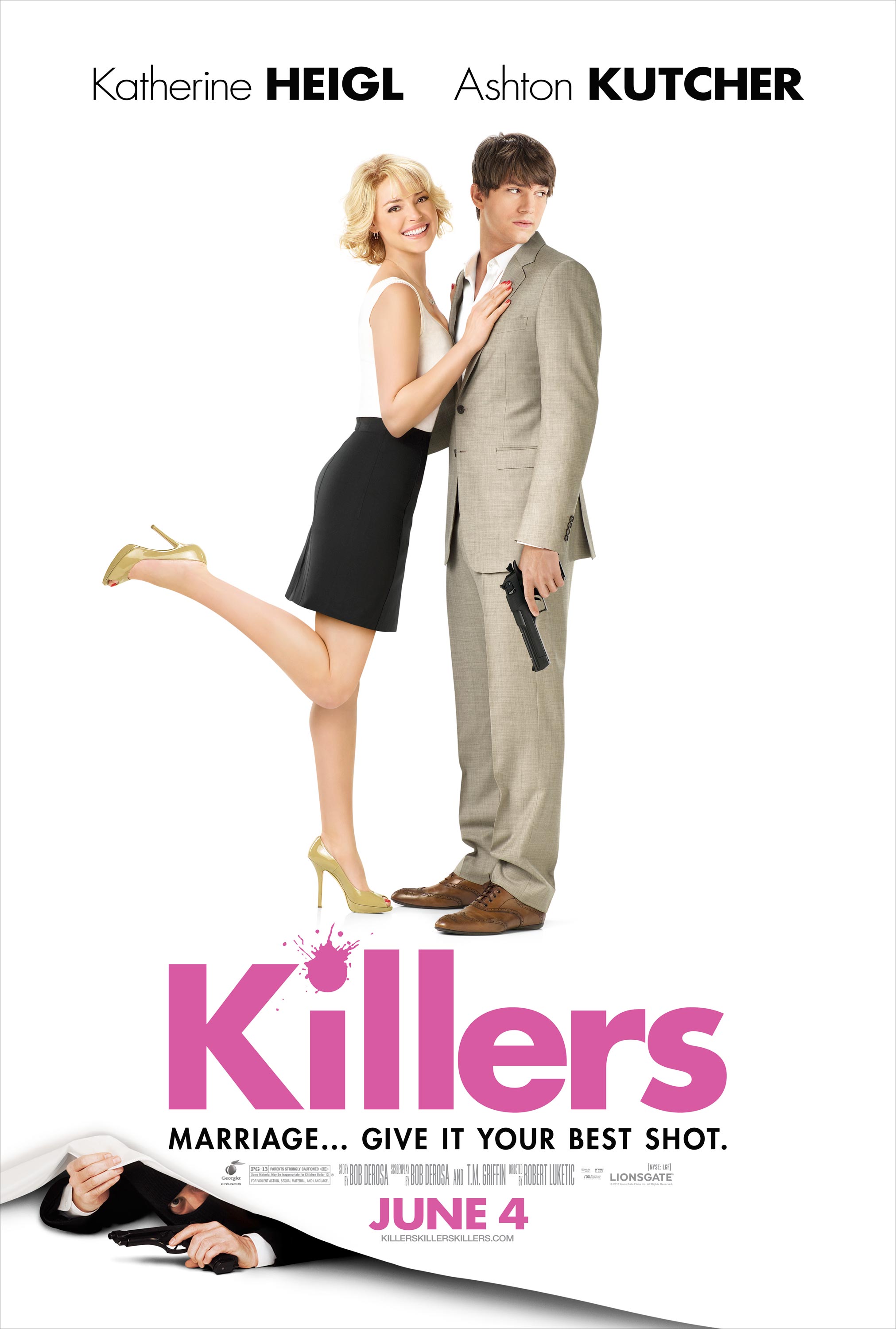
You remember 2010. It was a weird time for movies. We were right in the middle of that transitional phase where romantic comedies were starting to lose their iron grip on the box office, but studios were still throwing obscene amounts of money at them to see if they could pivot. Enter Ashton Kutcher and Katherine Heigl. At the time, they were essentially the king and queen of the mid-budget rom-com. Heigl was coming off 27 Dresses and The Ugly Truth, and Kutcher was basically the face of the genre after What Happens in Vegas.
Then came Killers.
It was supposed to be this massive, genre-bending hit—a mix of Mr. & Mrs. Smith and Meet the Parents. Instead, it became a fascinating case study in how two massive stars, a $75 million budget, and a decent premise can somehow result in something that feels remarkably empty. Honestly, looking back at Ashton Kutcher and Katherine Heigl in this film is like watching two people try to start a fire with damp matches. The sparks just wouldn't catch.
The $75 Million Gamble
Lionsgate went all in on this. At the time, Killers was actually the most expensive movie the studio had ever financed. They paid Katherine Heigl a staggering $12 million to star in it. Think about that for a second. In 2010, she was such a bankable force that she could command eight-figure salaries. Kutcher wasn't far behind in terms of cultural relevance, even if critics were always a bit harsher on his acting chops than they were on his "Twitter-famous" persona.
The plot was simple enough: Jen (Heigl) meets Spencer (Kutcher) while on vacation in Nice. He’s a super-assassin, she’s a "stuffy" tourist. They fall in love, he quits the business, they get married, and three years later, it turns out their suburban neighbors are all sleeper agents trying to collect a multi-million dollar bounty on Spencer's head.
On paper? It’s a fun ride.
In reality? It was a mess.
Lionsgate was so nervous about the final product that they actually refused to screen the movie for critics before it opened. In the industry, that’s usually a massive red flag. It’s the studio essentially saying, "We know this is bad, please just let us get the opening weekend money before the reviews kill it." It didn't really work. The movie opened to a mediocre $16 million and eventually clawed its way to about $98 million worldwide, which sounds okay until you realize the marketing budget likely doubled the production costs.
Why Ashton Kutcher and Katherine Heigl Didn't Click
People always talk about "chemistry" as this nebulous thing you can't define. But you know it when you don't see it. Most critics at the time—and fans who have revisited the movie on streaming—pointed out that Ashton Kutcher and Katherine Heigl felt like they were acting in two completely different movies.
Kutcher was trying to do this "cool, detached professional" thing. He got into incredible shape for the role, showing off a physique that was a far cry from his That '70s Show days. But he still had that puppy-dog energy that made it hard to believe he had ever actually killed anyone for money.
Meanwhile, Heigl was stuck playing the "neurotic blonde" trope that she had perfected but was clearly growing tired of. She spent a lot of the movie shrieking or looking confused.
"It's a killer the unstoppable force of Heigl meets the immovable object of Kutcher, and the results are staggeringly unpretty." — The Guardian
That quote basically sums up the professional friction. They weren't fighting behind the scenes—by all accounts, the production was professional—but their styles were oil and water. Heigl is a very "prepared" actress, focused on the beat and the timing. Kutcher is more of a "vibe" guy. When you put them together in an action-comedy, you get a movie that is neither particularly funny nor particularly thrilling.
The Supporting Cast Saved (Some) Face
If there’s any reason to watch Killers today, it’s not for the leads. It’s for the parents. Tom Selleck and Catherine O'Hara played Heigl's parents, and they were, frankly, acting circles around everyone else.
- Tom Selleck brought his classic "mustache and authority" energy as the suspicious, overprotective father.
- Catherine O'Hara was essentially playing a precursor to Moira Rose, constantly drinking from cartoonishly large martini glasses and delivering lines with a dry wit that the script didn't deserve.
There's a weirdly dark twist at the end involving Selleck’s character that actually makes the movie more interesting in the last ten minutes than it was for the first eighty. It’s the kind of twist that makes you wish the whole movie had been written with that level of edge from the start.
The Legacy of the "Peak Slop" Era
Some people on Reddit call this the "peak slop" era of Hollywood. It was that time when we were getting movies like The Bounty Hunter, Knight and Day, and Killers—all movies about gorgeous people in high-stakes situations that felt strangely low-stakes.
For Katherine Heigl, Killers marked the beginning of a cooling period for her film career. Shortly after, she had One for the Money, which also flopped, leading to her eventual pivot back to television with shows like Suits and Firefly Lane.
Kutcher, on the other hand, was already looking toward his future as a tech investor. While he continued to act, his focus shifted. He eventually replaced Charlie Sheen on Two and a Half Men, proving that his "everyman" charm worked better on the small screen than as a global action hero.
What You Can Learn from the Killers Blunder
So, what’s the takeaway here? If you're a fan of either of these actors, Killers is a fun time capsule. It’s a relic of a time when we thought star power alone could carry a thin script.
- Chemistry can't be forced. You can hire the two most beautiful people in the world, but if they don't have a natural rapport, the audience will feel the "work" they're doing.
- Genre-mashing is hard. Balancing "I might get shot" with "I think I'm pregnant" requires a very specific tone that director Robert Luketic just didn't hit here.
- The "Critic Block" rarely works. If a studio hides a movie, there's a reason.
If you’re looking for a nostalgic rewatch, go for it. Just don’t expect Mr. & Mrs. Smith. Expect a weirdly expensive, slightly awkward, but occasionally charming mess of a movie that reminds us why Ashton Kutcher and Katherine Heigl were the biggest names in the world for a brief, shining moment in the late 2000s.
Next Step: Check out the 2010 trailers for Killers versus the actual movie clips on YouTube; the marketing makes it look like a high-octane thriller, while the movie itself feels much more like a domestic sitcom with guns.