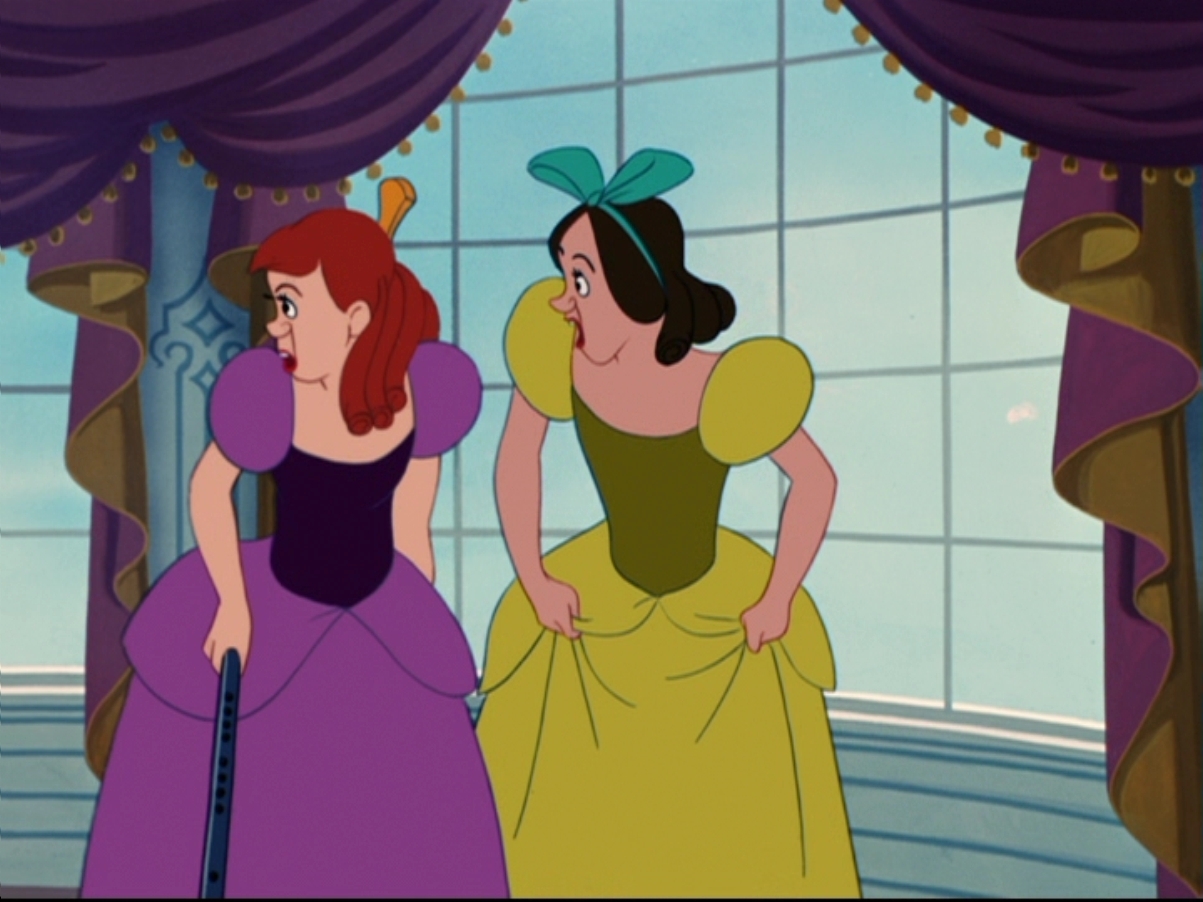
You’ve seen the blue dress. You know the pumpkin carriage. But if you’re trying to remember what is the names of cinderella’s stepsisters, the answer depends entirely on which version of the story is currently stuck in your head. Most of us instantly think of the 1950 Disney classic. In that neon-bright animation, the sisters are Anastasia and Drizella. They are loud. They are clumsy. They have those distinctively sharp noses that Disney used to signal "villainy" back in the day.
But here’s the thing.
Cinderella isn't just a Disney movie. It’s a folk tale that has existed for over a thousand years, stretching from 9th-century China to the courts of France. If you’re looking for the "real" names, you have to dig through layers of ink, parchment, and old-school Hollywood scripts.
The Big Two: Anastasia and Drizella Explained
Let's stick with the most famous ones first. In the Disney canon, Anastasia Tremaine is the younger one, usually depicted with red hair and a pink dress. Her older sister is Drizella Tremaine, the one with the brown hair and the yellow or green ensemble.
Disney didn't just pick these names out of a hat. They wanted names that sounded slightly pretentious, slightly "upper crust" but ultimately discordant. Interestingly, while Drizella stays pretty much a flat villain throughout the franchise, Anastasia actually gets a redemption arc in the direct-to-video sequels, Cinderella II: Dreams Come True and Cinderella III: A Twist in Time. She falls in love with a common baker. It’s actually kind of sweet. She learns that being "ugly" was more about her attitude than her face.
But if you go back to the source material that Disney used—the 1697 French version by Charles Perrault titled Cendrillon—the names are different. Perrault is the guy who gave us the glass slipper and the fairy godmother. In his original text, the elder sister is named Javotte.
The younger one? She’s just called "the younger sister" for much of the story, though some translations and adaptations of Perrault’s work refer to her as Florine.
Why the Brothers Grimm Didn't Give Them Names
It’s weird, right? The Brothers Grimm are the heavy hitters of fairy tales. Their 1812 version, Aschenputtel, is the one where the sisters literally cut off their heels and toes to fit into the golden slipper (yeah, it’s a gold slipper there, not glass).
In the Grimm version, the sisters are nameless.
They are just "the two sisters." They are described as beautiful on the outside but "black and ugly at heart." This is a massive departure from the Disney version where they are drawn to look physically unappealing. In the German tradition, the horror comes from the fact that they look like royalty but act like monsters.
The lack of names makes them feel more like a force of nature—a duo of cruelty rather than individual people. By the end of the Grimm story, birds peck their eyes out at Cinderella’s wedding. It's grim. Literally.
The Names Across Different Media
If you’re a musical theater geek, you probably know the Rodgers and Hammerstein version. This was originally a TV special starring Julie Andrews in 1957. In that version, the sisters are Joy and Portia.
Then you have the 1997 remake with Brandy and Whitney Houston (a literal masterpiece, honestly). In that one, the names changed again to Calliope and Minerva. Minerva is played by Natalie Desselle-Reid, and Calliope is played by Veanne Cox. They brought a high-energy, almost vaudevillian comedy to the roles that made the names stick for an entire generation of 90s kids.
A Quick Rundown of Sister Names Through History:
- 1950 Disney Film: Anastasia and Drizella.
- 1697 Perrault Tale: Javotte (and sometimes Florine).
- 1957/1997 Musicals: Joy and Portia, or Calliope and Minerva.
- 2015 Live Action: They kept the Disney names, Anastasia and Drizella, played by Holliday Grainger and Sophie McShera.
- Ever After (1998): This "historical" take renamed them Marguerite and Jacqueline. Jacqueline, played by Melanie Lynskey, actually ends up being Cinderella's ally.
Does the "Ugly" Label Still Matter?
We’ve spent decades calling them the "Ugly Stepsisters."
Modern retellings are moving away from that. Why? Because the moral of the story is changing. In the 2015 Kenneth Branagh film, Cate Blanchett’s Lady Tremaine isn't just "evil." She’s bitter. She’s broke. She’s desperate to secure her daughters' futures in a world that doesn't let women own property.
When you look at what is the names of cinderella’s stepsisters, you’re also looking at the evolution of how we view women in fiction. In the 17th century, Javotte was a warning against vanity. In the 19th century, the Grimm sisters were a warning against deceit. By the time we get to the 21st century, characters like Marguerite or the modern Anastasia are seen as victims of their mother’s ambition.
They aren't just names on a page anymore. They’re symbols of how parental pressure can warp a person's character.
The Semantic Evolution: From Javotte to Drizella
It is fascinating how "Drizella" has become a synonym for a mean girl. The phonetics of the name—that "Dr" sound—feels heavy and harsh. Compare that to "Cinderella," which sounds like "cinders" but has a soft, melodic "ella" at the end.
The name Javotte in French doesn't carry that same "mean" weight to a modern English ear, but at the time, it sounded common. Perrault was writing for the French court. He wanted the names to sound like people who were trying too hard to be fancy but weren't quite making it.
Why do people keep forgetting their names?
Honestly? Because Cinderella is the star. The sisters are "the obstacle." In storytelling terms, they are foils. Their names are often secondary to their function in the plot, which is to make Cinderella's life miserable so her eventual triumph feels earned.
If you are writing a paper or prepping for a trivia night, Anastasia and Drizella are your safest bets. They are the culturally dominant names. However, if you want to sound like a true literature expert, mentioning Javotte will definitely earn you some intellectual street cred.
Actionable Takeaways for Fairy Tale Enthusiasts
If you are researching this for a creative project or just deep-diving into folklore, here is how you should categorize these characters:
- For Disney Trivia: Stick to Anastasia (younger, red hair) and Drizella (older, dark hair).
- For Historical Context: Refer to Charles Perrault’s Cendrillon and use the name Javotte.
- For Literary Analysis: Focus on the Brothers Grimm and the fact that they remained nameless, emphasizing their role as archetypes rather than individuals.
- For Modern Adaptations: Look at Ever After (Marguerite/Jacqueline) or Confessions of an Ugly Stepsister by Gregory Maguire, which gives them the names Iris and Ruth.
The names change, but the dynamic stays the same. The stepsisters represent the external pressure to conform, the jealousy of grace, and the eventual failure of cruelty when faced with genuine kindness. Whether they are getting their eyes pecked out or finding love with a local baker, they remain the most essential "villains" in the history of the fairy tale.
Next time someone asks you about them, you can tell them it’s not just about a name—it’s about which version of the story you’re choosing to live in.