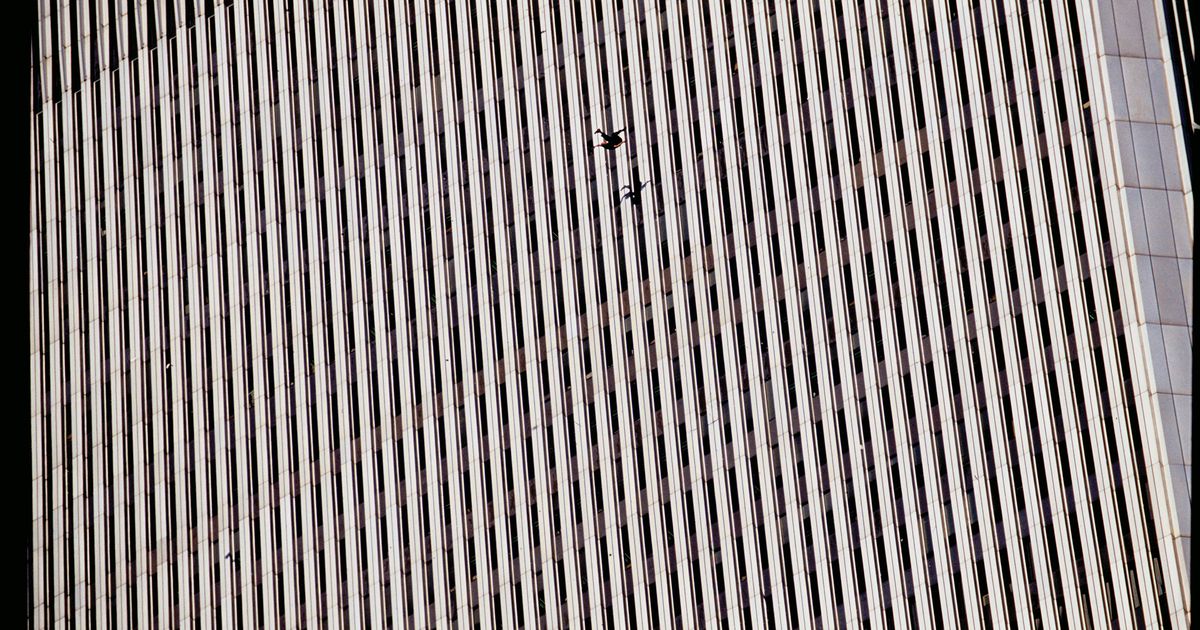
It’s been over two decades. Yet, for many who lived through that Tuesday morning, certain shapes still flicker in the back of the mind when the sky is too blue. You know the ones. They aren't the towers falling—that’s a collective trauma we've sanitized into a historical event. I’m talking about the 9 11 images jumpers that the media essentially tried to erase within forty-eight hours of the attacks. It's a heavy subject, honestly. It's probably the most visceral, gut-wrenching aspect of the entire tragedy, and for years, there was this unspoken agreement to just... not talk about it. We called it "the last taboo" of September 11.
History is messy. People didn't just "fall." They were forced out by heat so intense it was melting steel, or by smoke so thick it made lungs feel like they were swallowing glass. When you look at these photographs now, you aren't just looking at a tragedy; you're looking at a specific human choice made in a moment where no good choices existed.
Why we stopped seeing the 9 11 images jumpers in the media
Context matters. On the afternoon of September 11, 2001, and the morning of the 12th, these images were everywhere. They were on the front pages of local papers and lead stories on the nightly news. But the backlash was swift and it was brutal. Viewers called in, screaming that the photos were "exploitative" or "pornographic" in their sadness. Editors blinked. By the 13th, the 9 11 images jumpers had largely vanished from the American airwaves.
It's kinda wild how quickly a society can decide to look away from something it finds too painful to process. We wanted heroes. We wanted the "Falling Man" to be a footnote, not the lead. We preferred the images of the flags and the first responders—and they deserve that honor, obviously—but by scrubbing the jumpers from the record, we arguably did a disservice to the sheer horror of what those people faced in the North and South Towers.
The censorship wasn't a conspiracy. It was a collective flinch. Henry Singer, a documentary filmmaker who later tackled this subject, noted that the images challenged the narrative of a "brave" death. Society wanted to believe everyone died instantly or died fighting. The reality of someone having to decide between burning alive or falling is a level of darkness most people's psyches just couldn't handle at the time.
The Falling Man: More than just a photograph
You’ve seen it. Richard Drew, an AP photographer who had also witnessed the assassination of Robert F. Kennedy, took the most famous shot. It’s a man in a white tunic and black pants, falling perfectly vertical, head down, against the backdrop of the North Tower's steel ribs. It looks peaceful. Almost graceful. But that’s the trick of the camera. If you see the other frames in Drew's sequence, the man is flailing. He is tumbling. The "Falling Man" image is just one microsecond of a violent descent that lasted about ten seconds.
There was this huge push to identify him. For a long time, people thought it was Norberto Hernandez, a pastry chef at Windows on the World. His family was devastated. In a deeply religious household, the idea that their patriarch might have "jumped"—which some mistakenly equate with suicide—was a double trauma. They initially denied it was him. Later, Peter Cheney, a journalist, and eventually singer Gwendolyn Briley-Strand, pointed toward Jonathan Briley. Briley was an audio engineer who worked at the top of the North Tower. He had asthma. The smoke would have been his first executioner.
The physics of the fall
Let’s talk about the reality of what happened in those 1,300-foot drops. Physics doesn't care about our feelings. A human body falling from those heights reaches terminal velocity—about 120 to 150 miles per hour—in just a few seconds. At that speed, hitting the pavement or the plaza canopy isn't a "landing." It's an explosion.
People on the ground, like firefighters and journalists, described the sound. They said it sounded like "thuds" or "wet sacks" hitting the ground, but the frequency was constant. It was a rhythmic reminder of the failure of the world. Firefighters in the lobby of the North Tower had to listen to this while they were trying to organize a rescue mission they knew was likely a suicide one.
The numbers we don't like to count
Official records are weirdly quiet here. The New York City Medical Examiner’s Office has never officially categorized any of the 9/11 victims as "jumpers." Why? Because a jumper, in legal and medical terms, usually implies someone who went to a ledge with the intent to end their life. The people in the Twin Towers didn't want to die. They were "pushed" by the fire and the heat.
- Estimates suggest at least 200 people fell or jumped.
- Most were from the North Tower, where the fire was concentrated above the impact zone, trapping everyone.
- In the South Tower, fewer people jumped because one stairwell remained passable for a short time.
- The majority of these incidents happened between 9:41 AM and the collapse of the towers.
It’s important to realize that the 9 11 images jumpers represent about 7% to 8% of the total victims at the World Trade Center site. That’s a massive portion of the tragedy to just airbrush out of history books.
The ethics of looking
Is it wrong to look at these photos? Some say yes. They argue it’s a violation of the victims' privacy in their most vulnerable, final moments. They aren't wrong.
But there’s another side. If we don’t look, we don’t actually understand the magnitude of the crime. If we sanitize 9/11 into just a series of buildings falling down, we lose the human stakes. The people who fell were mothers, fathers, and coworkers. They were people who, in their final moments, sought out air. Some were seen holding hands as they fell. Some tried to make parachutes out of curtains or tablecloths. That isn't something to be ashamed of or to hide; it's a testament to the human will to survive or, at the very least, to control the manner of one's passing when all other agency is gone.
The psychological toll on the witnesses
We often forget the people who had to watch this from the ground. People in Battery Park. People in office buildings across the street. The 9 11 images jumpers are burned into the retinas of thousands of New Yorkers.
One witness, a woman who was just blocks away, described seeing a couple hold hands. She said she couldn't look away because she felt like she owed it to them to witness their life. That’s a heavy burden for a bystander. For the first responders, it was even worse. They were trying to save people while the "rain" of bodies made the plaza a literal deathtrap.
Redefining the "Choice"
Basically, we need to stop calling it a choice. It wasn't a choice between life and death. It was a choice between two different ways to die. When the temperature in those upper floors reached 1,000 degrees Fahrenheit, the skin starts to blister and the lungs sear. The windows were broken by people desperate for a breath of oxygen. Once you are leaning out of a broken window on the 105th floor, and the heat behind you is an oven, gravity becomes the only exit.
The "Jumpers" weren't giving up. They were escaping.
The global perspective vs. American media
Interestingly, European and international news outlets were much less "protective" of their audiences. In the UK and France, the 9 11 images jumpers were seen as a necessary part of the documentary record. There is a cultural difference in how we handle tragedy. In the US, we tend to lean toward the heroic and the sanitized. We want the movie version. But the movie version of 9/11 misses the raw, terrifying reality of what those individuals faced alone.
Moving forward with the memory
So, what do we do with this information? We don't need to stare at the photos all day. That’s not the point. But we should acknowledge that they exist. When you visit the 9/11 Memorial in New York, the "Reflecting Absence" pools are silent. They don't show the falling. But the museum does have a small, restricted area that discusses this aspect of the day. It’s handled with extreme care.
If you’re researching this, or if you’ve stumbled upon these images and feel overwhelmed, that’s normal. It’s a sign of empathy. The goal isn't to become desensitized. The goal is to understand that the tragedy of 9/11 was made of thousands of individual stories, and some of those stories ended in the air.
Actionable Insights for Processing This History:
- Read the primary accounts: Look for the "Falling Man" article by Tom Junod in Esquire. It is widely considered the definitive piece of journalism on this specific topic.
- Acknowledge the terminology: Stop using the word "suicide." The National Institute of Standards and Technology (NIST) and the Medical Examiner’s office have both clarified that these deaths were homicides caused by the hijackers.
- Support Memorial efforts: Visit the 9/11 Memorial & Museum's online archives to see how they preserve the stories of those in the impact zones without being sensationalist.
- Differentiate the "Falling Man" from the "Jumpers": Understand that while "Falling Man" is a specific person (likely Jonathan Briley), the "9 11 images jumpers" refers to the broader group of individuals who were forced from the buildings.
- Focus on the Human Element: When viewing any historical imagery, remind yourself of the names. Jonathan Briley, Norberto Hernandez—these were real people with lives, families, and favorite songs. They are more than just shapes in a photograph.
Understanding the 9 11 images jumpers isn't about morbid curiosity. It’s about refusing to look away from the full truth of that day, no matter how much it hurts. It’s about giving those people the dignity of being seen, even in their final, desperate moments of escape.