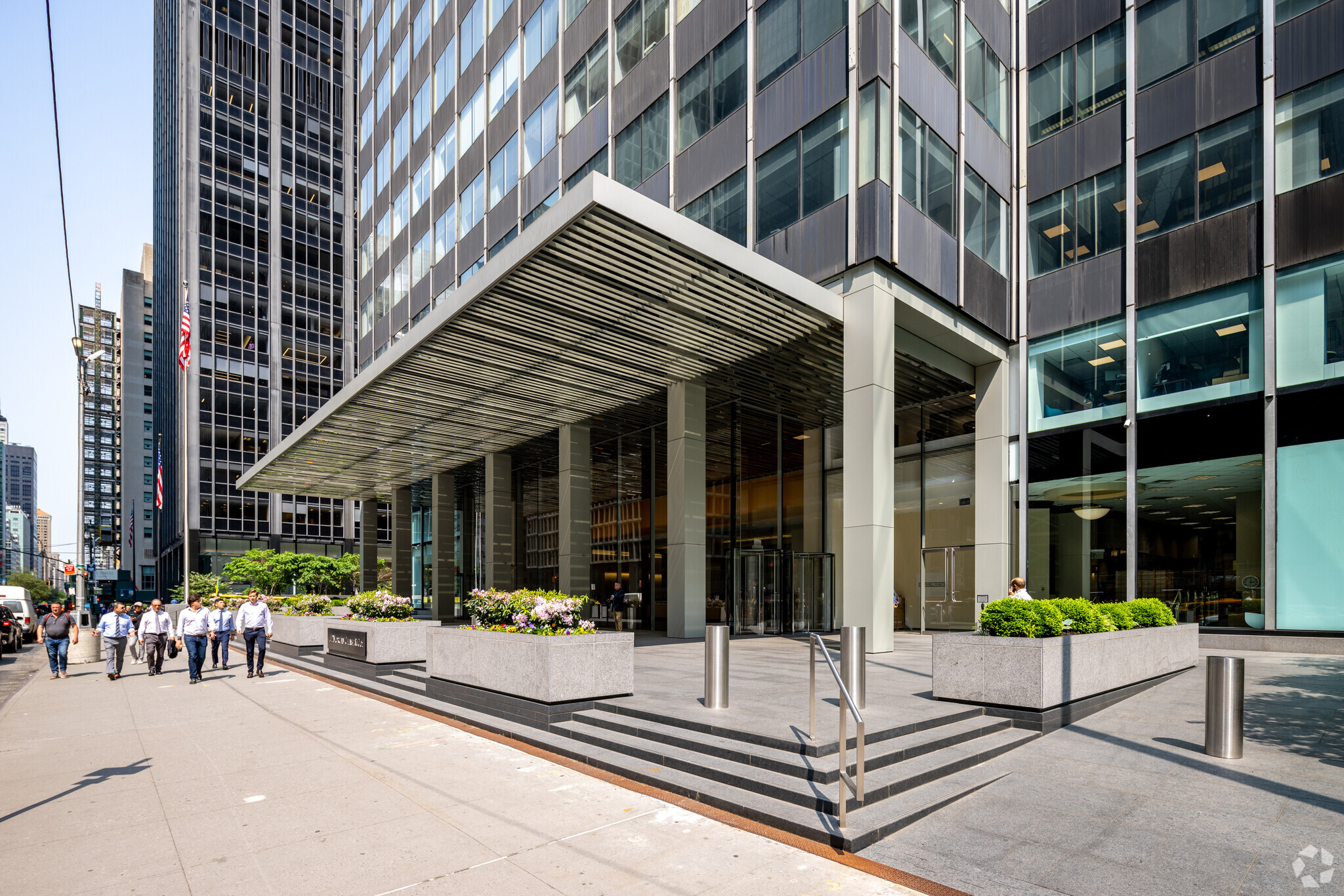
Walk down Park Avenue on a Tuesday morning and you’ll feel it. That specific, humming energy of old-school New York finance colliding with the shiny, glass-and-steel future of Midtown. Right in the thick of it stands 277 Park Avenue. It’s not the tallest building. It’s certainly not the newest. But honestly? It’s arguably one of the most successful pieces of real estate in Manhattan right now.
Most people just see a massive black skyscraper. They see a 50-story tower that looks like it belongs in a 1960s prestige drama. But if you actually look at the rent rolls and the recent $120 million renovation, you realize 277 Park Ave is doing something most aging office buildings can't. It’s staying relevant while everyone else is panicking about remote work.
It was built in 1964. Designed by Emery Roth & Sons. If you know NYC architecture, that name carries weight. They did the Pan Am Building—now the MetLife Building—just a few blocks away. They were the masters of the "corporate international style." Basically, they built the skyline that defines the Mid-Century American Dream.
The Stalwart of the Grand Central Submarket
Location is everything. People say that until it's a cliché, but for 277 Park Ave, it's the literal truth. You’re sitting right over the Metro-North tracks. You can practically smell the commuters' coffee from Grand Central Terminal.
For decades, this was the Chemical Bank building. Then it was the Manufacturers Hanover building. Eventually, through the dizzying series of mergers that defined 20th-century banking, it became a cornerstone for JPMorgan Chase. But something changed recently. JPMorgan is building its massive new headquarters right next door at 270 Park Avenue. You’d think that would be the death knell for 277. You’d think the tenants would flee.
Actually, the opposite happened.
The Stahl Organization, which has owned the building since they literally built it, saw the writing on the wall. They knew that in a post-pandemic world, a "standard" office wasn't going to cut it. You can't just offer desks and a lobby anymore. You have to offer an experience. So they poured nine figures into a redesign that focused on the ground level and the "vibe" of the place.
What the $120 Million Actually Bought
They didn't just paint the walls. They ripped open the plaza. They brought in David Childs and the team at SOM (Skidmore, Owings & Merrill). That's the same firm that did One World Trade Center.
They created a massive, double-height lobby that feels less like a bank and more like a high-end hotel. But the real kicker is the "Park Ave Kitchen." This isn't a cafeteria. It’s a dual-concept restaurant by David Burke. You have a "grab-and-go" side for the frantic analysts who haven't slept, and a sit-down, white-tablecloth side for the partners closing deals.
It’s smart. It’s strategic. It turns the building into a destination rather than just a place where you're forced to sit under fluorescent lights for ten hours.
The Tenant Mix: Who Actually Lives Here?
If you want to know if a building is healthy, look at who is signing the checks. 277 Park Ave has a roster that would make any landlord jealous.
- Visa: They took a massive chunk of space—roughly 190,000 square feet. Why? Because their workforce wants to be in Midtown, not far-flung Hudson Yards.
- Comerica Bank: Another heavy hitter in the financial sector.
- Sumitomo Mitsui Banking Corporation (SMBC): They’ve been an anchor here for years and recently recommitted.
- Agricultural Bank of China: Reinforcing the building's status as a global financial hub.
- M&T Bank: They recently joined the fray, taking over space as part of their NYC expansion.
It’s a mix of "Old Money" and "New Tech Finance." It works because the floor plates are huge—about 40,000 to 45,000 square feet. In the world of commercial real estate, those "rectilinear" floor plates are gold. No weird curves, no awkward columns in the middle of your trading floor. Just open, usable space.
The Mid-Century Modern Renaissance
There’s a weird thing happening in New York. Everyone thought the "Glass Box" era was over. We were supposed to be moving into "biophilic" buildings with trees growing out of the balconies.
But 277 Park Ave proves there is still a massive appetite for the "Power Building." There is something psychological about the black steel and the rigorous symmetry. It feels stable. When the market is volatile, companies want to be in a building that looks like it isn't going anywhere.
The renovation leaned into this. They didn't try to make it look like a tech startup in Brooklyn. They kept the dignity. They just made it... nicer. Better air filtration. Faster elevators. More light.
Why Most People Get the "Death of the Office" Wrong
You’ve heard the headlines. "Midtown is a Ghost Town." "Commercial Real Estate is a Ticking Time Bomb."
Kinda true, but mostly exaggerated.
What’s actually happening is a "flight to quality." If you own a "Class B" building on a side street with small windows and a smelly lobby, you're in trouble. But "Class A" assets like 277 Park Ave are actually seeing record-breaking rents in some cases.
Companies are downsizing their total square footage, sure. But they are spending more on the space they do keep. They want the best address. They want the David Burke restaurant. They want to be two minutes from the train. 277 Park Ave hits every one of those marks.
Navigating the Competition: One Vanderbilt and 270 Park
The elephant in the room is One Vanderbilt. It’s the shiny new skyscraper right across from Grand Central that charges eye-watering rents—sometimes over $200 per square foot.
Then you have the new JPMorgan tower at 270 Park. It’s going to be a 1,388-foot-tall behemoth.
How does 277 compete?
Value.
It offers the same prestige and the same location as One Vanderbilt, but at a price point that doesn't make the CFO faint. It’s the "sensible" luxury choice. You get the Park Avenue zip code, the brand-new amenities, and the high-end security without the "newest building in the world" tax.
Practical Insights for the Modern Professional
If you’re looking at 277 Park Ave, whether as a potential tenant, a real estate investor, or just someone interested in the heartbeat of the city, there are a few things you need to grasp.
First, the commute is the ultimate selling point. The opening of Grand Central Madison—bringing LIRR trains directly into the terminal—has been a massive boon for this building. Suddenly, your employees from Long Island don't have to trek to Penn Station and take the subway across town. They walk upstairs, and they’re at their desks.
Second, the "amenity war" is real. 277’s private club for tenants is a game-changer. It’s not just a gym; it’s a lounge, a meeting space, and a social hub.
Third, sustainability matters. Older buildings usually struggle here, but the recent retrofits have modernized the HVAC and energy systems. It’s not just about aesthetics; it’s about meeting the city's increasingly strict carbon emission laws (like Local Law 97).
What to Do if You're Visiting or Working Nearby
If you find yourself at 277 Park Avenue, don't just rush through the turnstiles.
- Check out the Plaza: It’s one of the few spots in Midtown where you can actually sit and feel the scale of the architecture without being trampled.
- Eat at Park Ave Kitchen: Even if you don't work in the building, the "to-go" side has some of the best high-end quick lunches in the area.
- Look Up: From the corner of 48th and Park, you can see the contrast between the 1960s black steel of 277 and the futuristic glitz of the new 270 Park. It’s a 60-year history of New York ambition in one frame.
The story of 277 Park Ave isn't finished. It’s a building that refused to become a relic. By investing when others were pulling back, the Stahl Organization ensured that this mid-century giant would remain a power player for the next fifty years. It’s a masterclass in how to manage a legacy asset in a changing world.
Next Steps for Stakeholders:
- For Corporate Tenants: Evaluate the floor plate efficiency. 277 offers a higher density of usable space compared to the core-heavy designs of newer, ultra-slim towers.
- For Urban Enthusiasts: Study the SOM renovation as a blueprint for "adaptive reuse" of commercial spaces. It’s a model for how the rest of the aging "Silicon Alley" and Midtown stock can survive.
- For Commuters: Utilize the Grand Central Madison connection to shave 20 minutes off your daily transit if you're coming from the East End.
- For Real Estate Observers: Watch the lease-up of the final remaining blocks of space; the price per square foot here will be the true bellwether for the "Return to Office" trend in 2026.